After South Korea come trips to Slovenia, Spain, and Italy.
The author shares highlights from the East Asian Forum of Nursing Scholars, which he attended in Seoul, South Korea.
 LONDON, United Kingdom—In less than a month, I have visited two countries divided by demilitarized zones: Cyprus and Korea. Cyprus, which seems to live with this reality very well, has, essentially, free movement across the zone. Korea lives less comfortably with theirs. Nevertheless, the zone between North Korea and South Korea (always referred to in South Korea as the DMZ) has, with typical Far Eastern entrepreneurship, become a tourist attraction. As one colleague aptly put it, “They have commercialized their difficulties.” I declined my opportunity to take a tourist trip to the DMZ, mainly because the temperature there was at -14 Celsius (6.8 Fahrenheit). It was not that cold in Seoul, but it was cold enough to make even the shortest walk—with four layers, hat and gloves—a miserable experience. Mostly, I moved between my hotel and the underground restaurants located at the basement level of the shopping malls. It reminded me of Toronto in winter.
I was in Seoul for the third time to attend, for the second time, the East Asian Forum of Nursing Scholars (EAFONS). This was the 21st EAFONS, and it attracted more than 1,000 people, significantly more than the few hundred delegates I recall in the early years. I was not invited this year to address the conference, and I decided not to submit an abstract. This gave me wonderful freedom to move among sessions and meet all sorts of interesting people.
The keynotes were of a very high standard with a range of North American and local speakers. Notably, Sally Thorne, PhD, RN, FAAN, University of British Columbia, Vancouver, Canada, addressed the conference twice. Her second paper on the value of qualitative research was one of the best justifications for the method I have heard, cutting through much of the obfuscation that I often associate with it. Sally and I are both Wiley editors. She edits Nursing Inquiry. Sarah Kagan, PhD, RN, FAAN, of the University of Pennsylvania, was also a keynote speaker. She edits the International Journal of Older People Nursing, which I launched many years ago as a supplement of Journal of Clinical Nursing. Under the initial editorship of Brendan McCormack, PhD, RN, of Queen Margaret University, Edinburgh, Scotland, UK, the journal soon became independent.
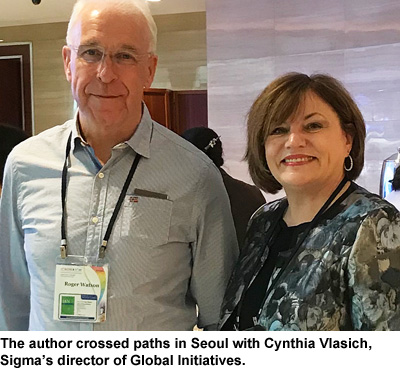 It was especially good to see Sigma’s continued presence at the conference and, even more, Cynthia Vlasich, MBA, BSN, RN, Sigma’s director of Global Initiatives. Both of us were members of the initial cohort of GAPFON global panelists. I also greatly enjoyed meeting more junior colleagues, particularly those I consider “rising stars.” Amongst those I met and spent some time with was Ken Ho, PhD, RN, Tung Wah College, Hong Kong, SAR, China. I first met Ho a few years ago in Hong Kong while he was still working toward his PhD. He submitted a manuscript that we published in Journal of Advanced Nursing, and I was impressed by his writing and clarity of thought.
In Seoul, Ho made a presentation in which he discussed his work with migrant workers who are hired by families to look after older members. A fraction of the thousands of migrant domestic workers in Hong Kong who come from poorer countries in the region, they have, traditionally, not had a voice among the local Hong Kong Chinese population. Ho is doing something unique and worthy, and he is winning the respect of the migrant domestic community.
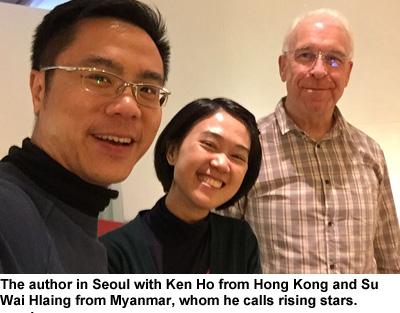 Another person I consider a rising star is Su Wai Hlaing, MSc, RN. She is from Myanmar, but works clinically in Singapore. She is the only Burmese person I know. As such, she has educated me about her country, which has been much in the news lately, and what it is like to work in Singapore. She provides a different perspective from the somewhat rarefied view I often get from senior academic colleagues. Hlaing recently completed her master’s degree through Edinburgh Napier University and is already putting her skills to work by leading a project in her hospital on the sexual needs of older people with stroke. Internationally, this is a largely neglected area and, locally, in a Southeast Asian culture, almost a taboo. I am convinced she will become a regional leader in nursing.
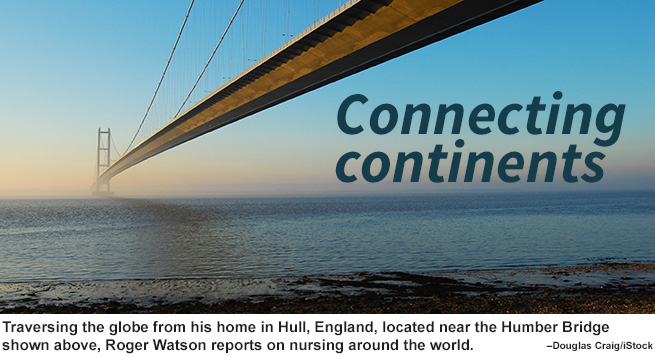
My year of connecting continents has begun. Next, I visit Slovenia and then Spain and Italy. The rest of my year’s schedule in the Far East and other places is not clear yet, but I have several invitations to honor in China, Hong Kong, and Taiwan. I also hope a symposium jointly submitted with Australian colleagues on the topic of open access and predatory publishers will be accepted for the 29th International Nursing Research Congress in Melbourne, Australia, in July. I’ll let you know. RNL
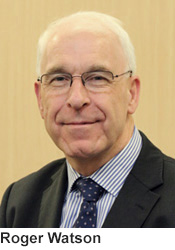
Roger Watson, PhD, RN, FRCP Edin, FRCN, FAAN, professor of nursing at the University of Hull in the United Kingdom and a frequent visitor to Australia and China, where he has visiting positions, is editor-in-chief of Journal of Advanced Nursing and editor of Nursing Open. Click here to access Blogger-resident entries posted before 2017 in Watson’s former blog “Hanging smart.”