Project fosters relationship between ‘sister’ nursing schools.
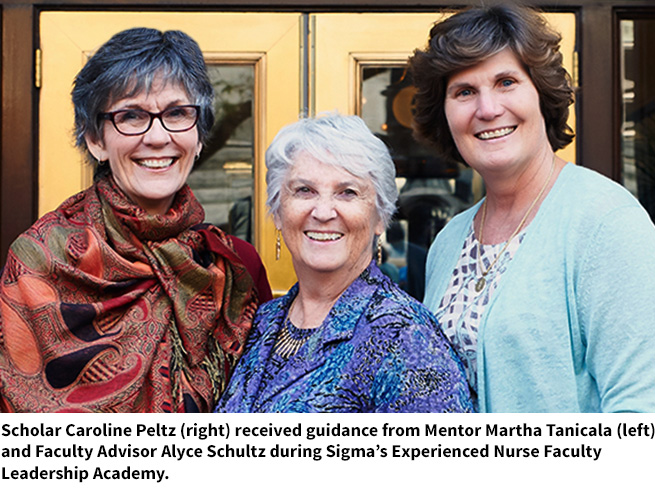
Participating in Sigma’s Experienced Nurse Faculty Leadership Academy increased her confidence and led to creation of Team Myanmar.
You have brains in your head. You have feet in your shoes. You can steer yourself any direction you choose. —Dr. Seuss, 1990
I never imagined that my curiosity about a leadership academy could lead to a program in Myanmar that has made a difference in the lives of so many people.
I first heard about the Experienced Nurse Faculty Leadership Academy (ENFLA) in 2016 at the Nursing Education Research Conference (NERC). After listening to extraordinary presentations by nurses in the program’s first cohort, I didn’t think I could qualify for the prestigious academy developed by the Sigma/Chamberlain College of Nursing Center for Excellence in Nursing Education.
Because the demands of raising my family were always a priority, I had paused my nursing career and changed focus several times. When I landed in nursing education more than 20 years ago, I taught mostly in associate degree nursing programs housed in community colleges. I now teach in a university setting with programs ranging from baccalaureate to doctorate education. But, I thought of myself as a junior faculty member who didn’t possess the knowledge, skills, and attitudes to be an ENFLA Scholar.
Many kinds of leadership
I later realized I had overlooked my previous leadership roles as a peer mentor, critical care nurse, and nursing preceptor. I had a degree in health administration, and, before embarking on a career in nursing education, I had been a nurse leader for a large healthcare institution. The kind words and support from Sigma ENFLA staff provided the initial push I needed to reignite my leadership drive.
When I approached my director, Michael Williams, PhD, RN, CCRN, CNE, for support in applying to the academy, he responded enthusiastically. Again, I wasn’t giving myself credit for my current leadership role as director of student success planning and the Nursing Learning Resource Center at Eastern Michigan University (EMU) School of Nursing.
My perception of myself in the university setting was beginning to improve. I mention this before reflecting on my ENFLA journey as a reminder that we often do not give ourselves credit for our successes. I humbly decided to move forward with the application process.
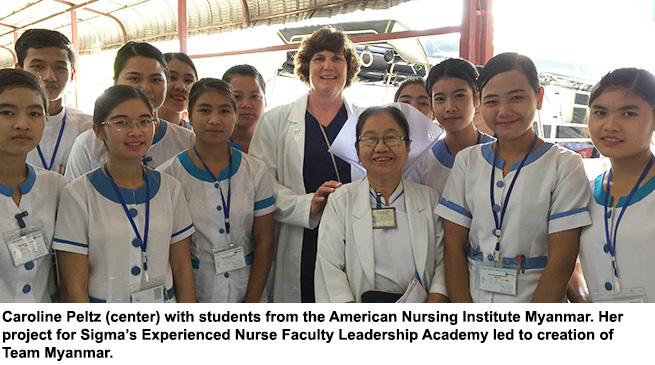
When applying for ENFLA, a potential Scholar is required to propose a leadership project. I had a wonderful conversation with my director about potential projects that would benefit our school. I was excited about developing a project related to advancing global health. Global Health Services Network (GHSN) had approached my employer, Eastern Michigan University (EMU), about an academic partnership with the first American school of nursing in Myanmar—American Nursing Institute Myanmar (ANIM).
My director asked if I would be interested in building a relationship with ANIM, our “sister” school of nursing. The contact person for GHSN and ANIM was Martha Tanicala, EdD, RN, a retired faculty member from my university. She became my assigned ENFLA Mentor and pursued the application process with me. When we were accepted into the 2016-17 ENFLA cohort, I knew that I had much to learn about leadership, global health, and international relationships.
Off I went to the first workshop in October 2016 with my Mentor to learn about the program and meet my Sigma Faculty Advisor, Alyce Schultz, PhD, RN, FAAN, who completed my triad. With their support and guidance, I brainstormed ideas about building relationships among my school of nursing, GHSN, and ANIM. What an incredible opportunity to refresh leadership conversations, learn about myself, network with others, and explore possibilities for the future. I learned more from the workshop than I had deemed possible!
Team Myanmar is born
I knew that I had to develop my leadership goals and grow my team very quickly. My goals were to 1) demonstrate that I act on what I value and have the best interest of others at heart (individuals will follow me based on my character), 2) be knowledgeable in my environment and not afraid to ask questions, and 3) embrace the strengths of others to attain goals and demonstrate that I am capable and credible in working toward a common goal.
My next step was to build a team. In November 2016, I approached the board of our local Sigma chapter, Eta Rho, about my leadership project. Eta Rho was looking for fresh ideas to stimulate members. Joining my team, which I now referenced as Team Myanmar, would be a win for all involved. I contacted the president of GHSN, Patricia Williams, and the dean of EMU College of Health and Human Services, Murali Nair, PhD. My team was rapidly growing, and key stakeholders were beginning to support me.
An additional requirement for ENFLA is to host a site visit for your Mentor and Faculty Advisor. I incorporated the site visit with the January 2017 program kickoff—which included introductions, dinner, and a presentation—that I had planned with the help of my chapter. The presence of my Faculty Advisor and Mentor held merit in the eyes of administration, faculty, and students and was crucial to the event’s success. Attendees included Eta Rho board members, EMU nursing faculty and students, the GHSN president and board members, and my dean and director!
We initiated fundraising initiatives to cover the cost of ANIM faculty visiting our school. Eta Rho helped with global partner shirt sales, bottle drives, bowling fundraisers, and dining for dollars. My dean and director felt that it was crucial to provide a face of our school at ANIM and asked if I was willing to travel to Mandalay, Myanmar. My Mentor educated me about international travel and nursing in Myanmar. She shared personal experiences of her past trips to ANIM as one of the founders of the school and gave me a shopping bag filled with basic needs for traveling to a “developing country.”
Cheers from ENFLA
I was naturally a little apprehensive about traveling halfway around the world by myself, but the ENFLA staff cheered me on. As I was preparing for my journey, I contacted Sigma’s Constituent Services Center staff to determine if the three ANIM faculty members who helped establish the school were eligible for membership. I was excited to learn that they met the requirements. I packed our chapter’s charter and honor cords to use for the induction ceremony while I was at ANIM. Fundraising proceeds paid for their memberships.
Armed with our school’s banner and textbooks, along with Florence Nightingale lapel pins, I took off for a three-week visit to Mandalay in March 2017. At the last minute, I learned that Shawn David, MSN, RN, ANIM project manager from GHSN, would meet me in Thailand, and we would travel together to Myanmar. With Shawn at my side, I knew my journey would be a success. We created a bond that continues to flourish today.
I knew that I needed to establish a sense of trust through face-to-face meetings in Myanmar. I didn’t want to come across as someone special or important—I was there to learn about health, nursing, education, and practice. I taught lab, clinical, and didactic courses for ANIM and worked with the English teacher to gather data on how ANIM students perceive and experience mentoring.
I also gave a presentation to the nursing staff at the three private hospitals associated with ANIM about Florence Nightingale and her improvements to nursing practice. To help the Myanmar nurses remember “the lady with a lamp” as our mentor, nurse researcher, and leader, I gave them a lapel pin in the shape of a lamp. Nurse leaders from all three hospitals have agreed to open their doors to future nursing students from EMU.
Thumbprints, not class portraits
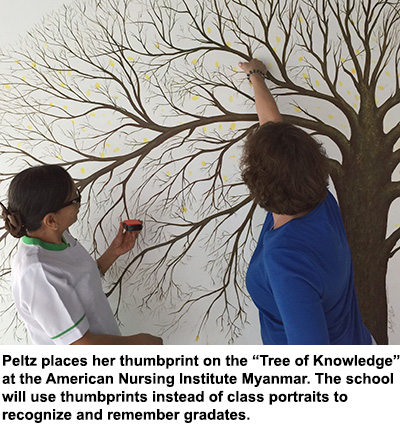 The entire school attended the induction ceremony for the newest members of Eta Rho. I was invited to place my thumbprint on the “Tree of Knowledge.” This was such an honor because the school will use thumbprints instead of class portraits to recognize and remember graduates. Our school truly has a face at ANIM!
After my return, I shared with my team not only my experiences but also the critical need for ANIM faculty to observe nursing curriculum and practice in America. Team Myanmar had (and still has) so much work to do. Eta Rho set a goal to bring two ANIM faculty to our school around the time of Sigma’s 44th Biennial Convention (28 October-1 November 2017) so that our global colleagues and newest members of Eta Rho could attend. With the support of the EMU dean and director, we met our goal.
EMU students and faculty welcomed ANIM faculty members at a bowling event the day of their arrival. While they were on our campus, we had a great exchange of nursing education and practice. We invited them to observe clinicals, labs, simulation experiences, and lectures across the undergraduate curriculum. With the help of Eta Rho, our team hosted an interdisciplinary global health panel to address the Sustainable Development Goals. Their stay culminated in a schoolwide “Thanksgiving” dinner, complete with turkey and all the trimmings, where all stakeholders celebrated the growth of our community and the relationships we had built.
Team Myanmar lives on
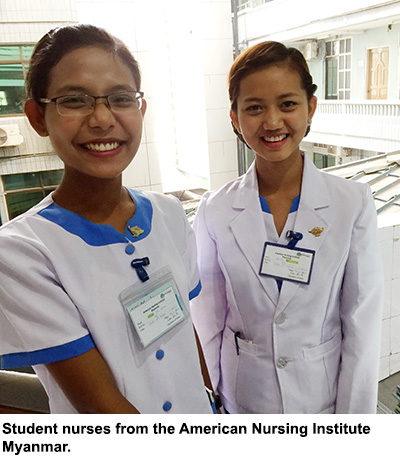 Our relationships have deepened and moved forward as Team Myanmar lives on. Students continue to gather and package medical supplies, equipment, and books our sister school needs. GHSN sends the items with those who are traveling to ANIM to ensure their arrival. Fundraising initiatives continue. Eta Rho is working to sponsor two students to visit our campus soon. Our team is developing student peer-mentoring initiatives and a faculty mentoring program based on data I gathered during my visit to Myanmar. We are also creating a study-abroad program for students enrolled in our school’s leadership course, and research projects on infection control and patient safety will create an evidence base for nursing practice in Myanmar.
I never imagined that my participation in a leadership academy could make such a difference. Jezudimbade (thank you), Team Myanmar, for helping me develop my leadership potential.
If you are interested in joining our team, please contact me at cpeltz@emich.edu. RNL
Caroline M. Peltz, PhD, RN, MSHSA, CNE, is associate director for undergraduate studies and assistant professor of nursing at Eastern Michigan University.
Apply now through 30 June 2018 for the Experienced Nurse Faculty Leadership Academy.