In 2025, I had the opportunity to explore parts of Belgium, including Brussels, Bruges, and Ypres, with plenty of time for museums and day trips. I decided to find as many references to nursing history as I could.
My time in Belgium reminded me that nursing has a rich and storied history and that there are countless nurses whose contributions deserve our respect and admiration. They did not have the benefit of our knowledge, research, and technology, but their
care was no less valuable to those who received it, and it should never be diminished. The search renewed and refueled my pride in the profession and in the admirable work done by those in nursing roles over the centuries.
Bruges
To go back as far as possible in the footsteps of nurses, I found myself in Bruges, where 12th-century St. John’s Hospital still stands. There are prominent references to those who provided nursing care there during the Medieval period.
I learned of the Beguines, women who eschewed both marriage and traditional religious life to instead form 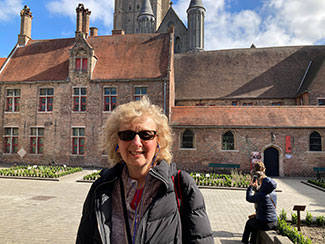 independent yet religious communities. These Medieval (and later) women worked in various roles, including nursing, outside their communities. They
built enclaves known as Beguinages (or Begijnhofs) that included housing, a church, and sometimes a hospital. The living quarters provided shelter for the Beguines and for women in need, a practice that continues in some of these hamlets
independent yet religious communities. These Medieval (and later) women worked in various roles, including nursing, outside their communities. They
built enclaves known as Beguinages (or Begijnhofs) that included housing, a church, and sometimes a hospital. The living quarters provided shelter for the Beguines and for women in need, a practice that continues in some of these hamlets
Although there are no longer any Beguines, their legacy lives on in the dozens of Beguinages scattered throughout Belgium and surrounding countries. I was fortunate to visit those in Bruges and Leuven. They are peaceful environments that still feel like
sacred and protective spaces.
Brussels
The Royal Military Museum in Brussels houses a vast and impressive collection of military artifacts. In the Medieval room, there is a small graphic related to women. I was not surprised to find that women were recognized for providing nursing care to
the sick and wounded over a thousand years ago.
I found nothing else about nurses until exhibits about World War I. There was a spectacular display of Red Cross nursing uniforms from various countries, along with medical equipment and supplies. Some of the supplies, such as bandages and syringes, carried
names and logos of companies familiar to nurses today.
But the most interesting part was what I learned about the Queen of Belgium—Elisabeth of Bavaria. During World War I, after she sent her children to safety, she stayed in Brussels. She visited the front lines, set up hospitals, and sponsored a Belgian
Nursing Unit. Queen Elisabeth is a little-known nursing heroine and came to be known as “Queen Nurse.”
Less than two decades later, at the start of World War II, many countries had established nursing in or adjacent to their militaries. The Royal Military Museum (Brussels) has examples of Army and Red Cross nurses’ uniforms for many of the
countries embroiled in the conflict. They are wonderful to see and help you imagine what it was like to serve in that war.
Ypres (Hill 60/Flanders)
Then, I stepped back in time to World War I during a tour of the Ypres area, the front line and scene of several major battles.
We walked on Hill 60, which has been preserved to reveal the effects of bombing. Large craters, bomb shells, and bunkers. Markers show the surprisingly short distance between the Allied and German front lines.
After a quick walk across “No Man’s Land,” once an area of indescribable devastation and death, we descended into an excavated trench. We visited the cemetery at the site of an aid station where John McCrae wrote his heart-wrenching
poem, “In Flanders Field,” and gazed at the sites of some of the bloodiest battles.
The battlefields have now been returned to peaceful farmland, but the farmers still dig up military equipment and skeletons annually.
Ypres, completely destroyed and painstakingly rebuilt, features the fantastic In Flanders Field Museum. Housed in the reconstructed Medieval Cloth Hall, the museum offers an extensive display about the nurses, physicians, and ambulance drivers who cared
for the wounded. One of the most moving experiences is watching the 3-D videos of actors impersonating and reading the words of actual nurses who cared for the horrifically injured soldiers. The technology is entirely convincing—the closest
one can come to seeing and hearing a WWI nurse.
The Belgian people continue to commemorate the events of WWI. The “Last Post Ceremony,” held each evening beginning in 1928, is an ongoing tribute to those lost in WWI and attended by many groups from Belgium and beyond, who lay wreaths at
the Menin Gate memorial.
Bastogne
In Bastogne, I continued my journey and discovered a little bit about nurses during WWII. There, the outlines of American foxholes from the Battle of the Bulge in the Ardennes Forest are visible and bullet holes are still visible in buildings in Foy.
Last year was the 80th [CS3] Anniversary of the Battle of the Bulge, a turning point in the war in the winter of 1944 to 1945. The town of Bastogne suffered massive destruction and was the location for a hospital to care for the wounded.
Belgian nurses Renée Lemaire and Augusta Chiwy are remembered and revered by the Belgians for their lifesaving work at the hospital. Their service is immortalized in the book and television series, Band of Brothers. They were living in the
blood of the wounded, coping with massive injuries and extremely limited supplies. It is difficult to envision the carnage, but easy to admire the selflessness and courage of these nurses. Renée Lemaire was killed in a direct hit on the hospital.
She paid with her life for her service. Augusta Chiwy lived until age 94 and was made a Knight in the Order of the Crown by King Albert II of Belgium for her wartime contributions.
My journey through Belgium in the footsteps of nurses makes me think of my favorite literary passages from the end of Middlemarch by George Eliot,
“…for the growing good of the world is partly dependent on unhistoric acts; and that things are not so ill with you and me as they might have been, is half owing to the number who lived faithfully a hidden life, and rest in unvisited
tombs.”
I like to think that in some small way, I visited them to offer my profound respect.
Katherine Kuren Black, MSN, RN, is the Program and Data Manager for the HRSA grant, Seton Hall University and City of Newark Nurse-led Mobile Health Training Program, Nutley, NJ, USA. She is the past president of Sigma’s Gamma Nu Chapter at
Seton Hall University in New Jersey, USA.