‘I cannot say enough about my EEAI experience.’
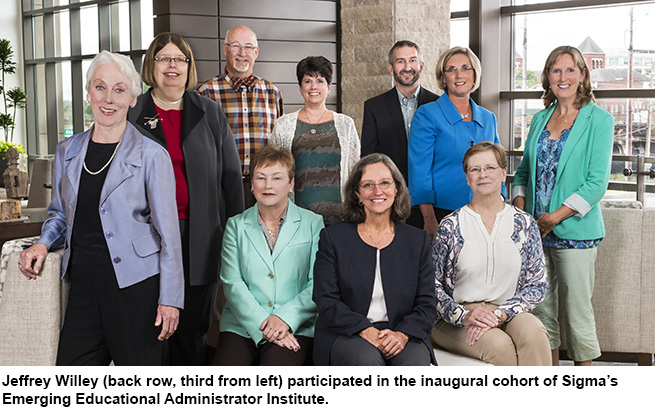 A participant in Sigma’s Emerging Educational Administrator Institute discusses benefits of the mentored leadership program.
I have often thought of leadership as a means to an end, but after attending the Emerging Educational Administrator Institute (EEAI), presented by Sigma Theta Tau International Honor Society of Nursing (Sigma), I have come to realize that leadership is just the beginning.
 Nursing became a second career for me after many years as a medical technologist. I saw nursing as a career in which I could move up and work directly with patients and their families. I was excited about this aspect, and after graduation, I started my nursing career on an ICU step-down unit.
From there, I realized that, although I loved working on the floor, I wanted to do more and thus decided to continue my education. I already had a Master of Education degree and knew that I loved teaching. So, I decided to pursue a Master of Science in Nursing (MSN) while working in the Medical Intensive Care Unit (MICU).
After earning my MSN, I started work as an administrator in the ICU. Faculty from a local university asked if students could visit the ICU. Because the students were involved in caring for ICU patients, I was asked to be an adjunct clinical instructor. Once I began, I was hooked.
After teaching as an adjunct, I received an offer to teach contractually. I was leery of taking on a contract position, but I came to realize that I truly enjoy teaching, so I accepted the offer. At this point, I was already engaged with my PhD in Nursing program and was enjoying both teaching and learning.
I then was asked to step into a leadership position to cover for a sabbatical and found I liked that role. After completing my PhD, I worked as an interim administrator and, after one year, became the official administrator.
Then came the moment when I was elected to serve as chair of the department. I have now been in this role for three years and will serve for two more as we transition into a School of Nursing in a new College of Health and Human Services. Each position has been a learning experience, and I have loved the quirks and responsibilities of each role.
Sigma launched the EEAI program at the beginning of my first year as chair. I reviewed the description and thought the program was just what I needed. Serving as chair is vastly different from my previous roles. In fact, working in academe is different from any other professional role I have taken on.
After I was accepted into the institute, our group of nine met in Indianapolis for a workshop. During the sessions, we learned about our own leadership styles by completing self-inventories. This was a great learning experience because it allowed us to discover more about ourselves and how we deal with various challenges and opportunities. During this meeting, we also began to develop our networking skills. Networking, for me, is one of the most significant benefits of this program—more about that later.
Since completing the program, I have come up with my own leadership style—SMILE—which stands for Situational Managing In Leadership Experiences. This style contrasts with FROWN, an acronym for Frequent Reactivity Over Whining and Noise. Through reading leadership articles and books, I learned that, in business, we spend too much time trying to bring the lowest-scoring people to higher levels, instead of working with individuals in the middle, whom we can truly influence to make a difference (Heath & Heath, 2017). This idea follows the squeaky wheel analogy or the 80/20 rule. I started thinking about why I was spending so much time on negatives instead of focusing on positives and supporting individuals in the middle. This has shaped how I now perceive and deal with issues.
One other item of note is the hot topic of leadership succession. At a recent conference, I heard a leader say she was always the first in the office and the last to leave. This working style needs to be re-evaluated. If aspiring leaders see nurses in positions above them stressing out and working extra hours, why would they consider taking on a similar role? Leaders need to make leadership appealing. I must admit that I have days when it’s an effort to smile. But most of the time, I enjoy what comes my way. Fortunately, I work with faculty, staff, students, and administrators who support me and make my role enjoyable.
I also don’t agree with the adage “It’s lonely at the top.” I believe this is a self-fulfilling prophecy. It’s lonely because one makes it lonely. Participating in EEAI allowed me to network with individuals in similar roles and also with experienced nurses who had “been there, done that, and got the T-shirt,” so to speak. These nurse leaders gave me practical advice based on their lived experiences. This was a huge benefit to me, and I carry on these relationships to this day.
I cannot say enough about my EEAI experience. The program has encouraged me to continue to grow during my leadership journey and life in general. Becoming an effective leader is well worth the effort. RNL
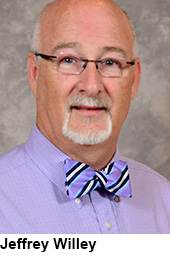
Jeffrey Willey, PhD, RN, CNS, CLNC, CNE, is chair of the Department of Nursing at Salisbury University in Salisbury, Maryland, USA.
Reference:
Heath, C., & Heath, D. (2017). The power of moments. New York, NY: Simon & Schuster.