Shared governance is continually evolving.

Chapter 2 of Rethinking Your Unit Council Structure, published by Sigma, focuses on shared governance history, external influences on governance, and challenges of traditional models.
“The leader is one who mobilizes others toward a goal shared by leaders and followers. ... Leaders, followers and goals make up the three equally necessary supports for leadership.”
—Gary Wills
History of shared governance
The shared governance model was introduced in the early 1980s and is a continually evolving framework that supports professional nursing practice and decision-making. Within a shared governance structure, clinical nurses experience autonomy and are empowered and supported by organizational leadership to tackle issues that affect their practice. A successfully designed governance structure can lead to improved clinical outcomes, improved employee satisfaction and retention rates, future leadership development, and increased employee engagement (Caramanica, 2004; Porter O’Grady & Finnigan, 1984; Porter O’Grady & Malloch, 2003; Porter O’Grady & Wilson, 1995).
 Professional governance is as much a structure and a process as it is an ideology. For professional governance to be fully functional, a structural foundation is required to allow and encourage ideas and work to flow without unnecessary barriers. Ideally, this structure includes decision-making at the bedside, through unit councils, as well as decision-making at the organization level, through hospital-wide councils.
The intention of professional governance at the unit level is to give every clinical nurse the opportunity to be involved in their practice and to have a clear path to champion an idea for change. Professional governance is the structure that allows the thoughts, perspectives, expertise, and influence of clinical nurses to be at the table regarding decisions around nursing practice and the practice environment. Professional governance, when compared to traditional governance, allows for decisions and influence to be closer to the point of care and encourages teamwork, partnerships, and a spirit of engagement.
Professional governance concepts
The specific way an organization structures governance can vary and yet be quite successful. While there is no ideal structure, a successful structure creates an environment where nurses and interprofessional partners want to practice. According to Porter O’Grady, Hawkins, and Parker (1997), when an organization embraces professional governance concepts, the culture shifts toward work that supports the following principles:
- Partnership
- Equity
- Accountability
- Ownership
Partnership
The principle of partnership centers on building relationships between stakeholders and ensuring all key players are present and at the table when discussing change. The perspectives of nursing leaders, clinical nurses, interprofessional partners, and patients and family members are valued when considering solutions to issues. These strong partnerships ensure that issues are evaluated from multiple perspectives and that the final decision has the optimal opportunity for success. When healthy partnerships exist, outcomes are better, and processes are stronger.
Equity
The principle of equity is based on the belief that every role is important, and no one role or perspective holds more influence than another. The focus moves from power gradients driving decisions to decision-making around the point of care with the focus on improving structures and processes. Equity enhances partnerships and ultimately improves the work environment and clinical outcomes.
Accountability
The principle of accountability is core to the success of a governance model. In traditional governance, decisions about change and how to implement it are typically directed by leaders to their employees. Often the result is frustration—frustration by employees who may see a better way and frustration by leaders when expected results are not achieved. Within professional governance, clinical nurses are empowered to make decisions that affect care delivery, quality and safety, professional practice, and their work environment. With role clarity and a focus on outcomes and partnerships, accountability is shared, and individuals involved in the change feel valued and appreciated for their contributions.
Ownership
Ownership is the personal commitment made to support the vision and the work of the organization. There is an acceptance of the importance of every- one’s work and the understanding that an organization’s success depends on the ability and evidence of individual employees to perform at the highest level of competence and skill.
Click here to read the rest of Chapter 2 and view supplemental materials from Rethinking Your Unit Council Structure in the Virginia Henderson Global Nursing e-Repository of Sigma Theta Tau International Honor Society of Nursing (Sigma).
Click here to buy at the Sigma Marketplace. RNL
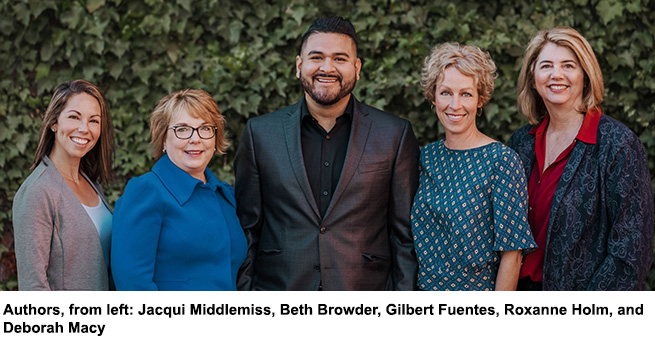
Beth Browder, MHSA, BSN, RN-BC, NE-BC, is the executive director for professional nursing practice, quality, and education and the Magnet program director for John Muir Health.
Gilbert Fuentes, MSN, RN, CMSRN, ONC, is the adult acute care nursing manager for medical telemetry at John Muir Health.
Roxanne Holm, MSN, RN, RN-BC, is a nursing professional development specialist in acute care at John Muir Health.
Deborah Macy, BSN, RN-BC, is a unit supervisor on a medical-surgical unit that specializes in endocrine, renal, and stroke patient populations at John Muir Health.
Jacqui Middlemiss, BSN, RN, ONC, CMSRN, is a clinical nurse and relief charge nurse on a medical-surgical unit that specializes in endocrine, renal, and stroke patient populations at John Muir Health.