Nursing is inherently political.
As nurse advocates, we aim to shift leaders’ mentality on national/global policies that improve processes and systems to be more equitable—for our patients, for us as nurses, and for the communities we serve.
Because of this, some of us have opted to not only think globally and act locally, but to think globally and act globally as well.
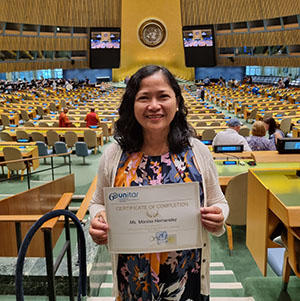 I have done so as a fellow of the Global Diplomacy Initiative of the United Nations Institute of Training and Research (UNITAR). UNITAR is the principal training arm of the United Nations. I came across this programme when I stood as a New Zealand Parliamentary Candidate during the pandemic. I led the party vote win in the East Coast Bays region by gaining 40% of the electorate votes, a first for an Asian immigrant and nurse who stood against a local. As part of the fellowship, I attended a series of webinars for a full term and submitted a research paper on a relevant global concern that requires the use of science and global diplomacy.
The programme strongly emphasizes gaining a comprehensive understanding of global affairs and the Sustainable Development Goals (SDGs), while equipping fellows with the knowledge and skills necessary to navigate the complexities of the international landscape. It offered a unique opportunity to engage with and learn from seasoned diplomats who are actively shaping international relations and politics.
During my fellowship, I learned about science diplomacy and realised how closely linked it is to what we do in Sigma. With my knowledge of the interrelatedness of the social determinants of health and diplomacy, expertise in infection prevention and control, and experience in public health as a frontline lead in New Zealand’s Emergency Response during the pandemic, I advocated for global antimicrobial stewardship at the UN General Assembly.
What is science diplomacy?
First, let me define what I mean by science diplomacy. Science diplomacy is the fusion of two distinct elements:
Science is an evidence-based method of acquiring knowledge.
Diplomacy is a sensitive and tactful way of managing international relations characterized by dialogue, negotiation, and sometimes, compromise.
The concept can be traced back to the British Royal Society and the American Association for the Advancement of Science meeting in 2009, where science diplomacy was conceptualised with the following pillars:
- Science in diplomacy—where people with formal science education serve as professional diplomats, e.g., adoption of the World Antimicrobial Awareness Weeks, where health professionals, including nurses, help increase public understanding of antimicrobial resistance.
- Diplomacy for science—where professional diplomats broker international scientific cooperation across several countries. An example of this is the designation of 2020 as the International Year of the Nurse and Midwife, where scientific activities focused on research and technological implementation.
- Science for diplomacy—where international relations are strengthened by scientific cooperation between countries through the exchange of individual scientists.
In summary, science diplomacy is global politics pushed by science through diplomatic methods.
Speaking at the Science Summit of the UN General Assembly (UNGA78)
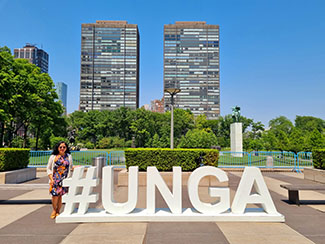
Being a Sigma nurse in action, a global diplomacy fellow, and an infection control practitioner, I jumped at the opportunity to speak at the Science Summit of the UN General Assembly in 2023 (UNGA78) about the current global challenges of antimicrobial resistance (AMR), how it is impacted by climate change, and the role of science diplomacy in addressing the challenges of international collaboration against AMR.
Since nursing is a science-based discipline, nurses have the knowledge and ability to address AMR as a global emergency.
The global spread and continuing prevalence of AMR is influenced by socio-economic determinants aggravated by poor governance, irrational human practices, poverty, lack of education, and a lack of access to healthcare. Environmental conditions linked to climate change act as AMR transmission networks, such as antimicrobial-rich wastewater and sludge due to antibiotics excreted in active form, and ecosystem contamination with animal faecal matter containing drug-tolerant bacteria and antibiotics.
Pandemics, disasters, and health and human rights are other global health issues that Sigma can address through science diplomacy.
SPONSORED CONTENT
Science diplomacy and Sigma
Sigma’s commitment to advancing nursing knowledge transcends education and research. I have personally stayed a Sigma member, not just to pursue nursing excellence, but also to channel nursing excellence into service to humanity by helping address the social determinants of health.
Science diplomacy is exemplified by Sigma’s advocacy for nurses to have a better understanding of, and to act towards achieving, the Sustainable Development Goals (SDGs). With Sigma’s global reach, it has the ability to advocate for health equity and a more sustainable future for all by 2030.
Science diplomacy is also exemplified by Sigma’s advocacy for ethical international nurse recruitment, together with the International Council of Nurses, where global leaders are encouraged to be ethical in their nurse migration policies and to ensure that these policies are supported by scientific evidence from the nursing community. Ethical recruitment involves developing policies and strategies that support internationally educated nurses and nurse retention.
Sigma’s work at the global level is more complex than what has been explained above. With changes in the geopolitical landscape of health and healthcare, Sigma’s commitment to achieving the SDGs and health equity remains incredibly important.
Conclusion
Nursing and the scientific community have a role in advocating for health equity and urgent action to achieve the SDGs and address global health issues through science diplomacy.
Sigma is doing its part. Individual nurses should stay informed, be active on The Circle where nursing advocacy and the SDGs are discussed, and take part in global advocacy and science diplomacy for issues that affect nursing and health.
Adjunct Professor Monina Hernandez, MN(Hons), PGCTT, GradCertPH, BSN, RN, FCNA(NZ), FGDI, MACN, CGNC, is a multi-awarded ICN-CGFNS certified global nurse consultant, an infection prevention and control expert, higher education academic, and doctoral candidate at Deakin University, Australia. She is a member of the Psi Zeta at-Large Chapter.