In nursing, we often refer to new graduates as newly minted. Like mints, some are soft, others spicy. They are fresh and full of potential, yet too often left sitting in the candy dish, overlooked for leadership and professional organization roles.
For many new nurses, the first year is spent adjusting to 12-hour shifts, following clinical routines, and demonstrating competence—all while building confidence. Yet some break the mold and seek professional service and leadership positions within
their first year of practice. This reflection offers two perspectives on early leadership from a new graduate nurse and a seasoned faculty member.
Fresh Mint: A new grad’s perspective
When I graduated from nursing school, people told me to “just focus on surviving the first year. Get used to the flow of working nights.” I understood the wisdom in that, but I also knew that I didn't have to wait until I had years of experience
to be a leader.
My Sigma journey began when I joined my first chapter meeting as a student, unsure of what to expect. What I found was a room full of nurses who didn’t ask how long I’d been a nurse, but rather, how I wanted to contribute.
I was hooked.

That first meeting led me to get involved, and over the past year, I served as the Leadership Succession Committee Chair for our Sigma chapter. In that role, I helped bring ideas to life, most notably a campus-wide Heart Health Awareness event in collaboration
with the National Student Nurses’ Association and the Simulation Lab. More than 20 students participated in Code Blue simulations, hands-on skills stations, and learned from two cardiac guest speakers.
I also helped launch a Chipotle fundraiser (because meaningful work pairs well with burritos) and created a social media presence to connect members and boost engagement across our chapter.
The more involved I became, the more I realized how powerful Sigma’s mission truly is. Encouraged by the mentorship and support I found within the chapter, I decided to run for vice president. Being elected felt incredibly affirming, not just personally,
but as a reminder that leadership isn’t about years of experience; it’s about initiative, follow-through, and heart.
Being a recent graduate did not restrict my capacity to lead. Instead, it provided me with a distinct perspective. Every policy discussion had a real-time connection to the patients I was taking care of. Every conversation about advocacy was connected
to the experiences I had gone through during shifts.
Leadership gave me a sense of belonging and reminded me that even as a new nurse, I already had something meaningful to contribute. The learning curve is real. Some days it feels like I’m drinking from a firehose, but I’ve learned that small wins matter.
Balancing both worlds isn’t always easy. Twelve-hour shifts can stretch me thin, and stepping into meetings and committees outside of work has sometimes felt like taking on a second full-time job. But it also gave me purpose during the transition every new nurse faces. The period where I’m still learning, still adjusting, and still finding my place in the unit.
Leadership gave me a sense of belonging and reminded me that even as a new nurse, I already had something meaningful to contribute. The learning curve is real. Some days it feels like I’m drinking from a firehose, but I’ve learned that small wins matter. Starting an IV on the first try, advocating for my patient’s needs, or receiving heartfelt gratitude at the end of a shift all built my confidence and reaffirmed why I chose this profession.
Stepping into leadership as a newly minted nurse taught me that nursing isn’t just about what happens at the bedside—it’s also about how you show up for the profession.
At Sigma, I found exactly that: a community of nurses who welcomed new perspectives, challenged me to think beyond the bedside, and reminded me that leadership is not defined by age or tenure. It’s defined by intention.
Wise Sage: A faculty member’s perspective
My faculty perspective represents that of the wise sage. The herb sage has distinct properties, flavor, and aroma, yet it shares common roots with mint—they are part of the same family. Metaphorically, like the sage and mint, new and seasoned nurses,
and faculty are part of the same family and share common roots inherent to the profession.
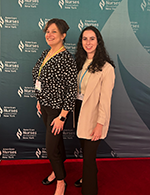
If different herbs can grow together in the same forest, then so can new nurses into leadership positions while mentored by seasoned nurses and faculty.
Too often, I’ve observed new nurses feel small in large organizational spaces, believing they are not quite ready for a leadership role or that their focus must be solely on the clinical aspect of nursing. This raises an important question: are
these feelings a natural part of becoming a new nurse, or are they shaped, often unintentionally, by the interpreted messages during nursing education and early professional practice?
What struck me about Michelle, even as a student, was her fearlessness, as evidenced by her attendance at Sigma meetings as the only student and by her poster presentation at a national conference. Throughout her time as a leader in our student chapter
of the National Student Nurses’ Association and Sigma member, she consistently showed up and put herself forward.
You might think that the most vocal students earn leadership positions, but it’s more about courage.
Attending a meeting, expressing interest, stepping out of your comfort level, speaking at an event, or presenting a poster despite uncertainty are seemingly small actions. But they demonstrate determination and are early signs of emerging leaders. When
a student exhibits these signs, faculty should nurture and support them in their growth.
Why should new graduate nurses be invited into leadership early? First, new nurses bring tech-savvy skills that can advance nursing organizations on social media. That first year of practice can be intimidating, but a leadership role sends the message
that your voice and opinion matter. When new nurses see themselves as contributors rather than just staff, they are more likely to remain engaged in the profession. Second, most new graduate nurses work at the bedside and can offer real-time insight
into the clinical setting, making their perspective especially valuable in leadership and professional organizations. New nurses are a fresh set of eyes and offer a unique perspective. And above all else, their energy and spirit make them fun to work
with.
Michelle Novominski is a registered nurse at Lenox Hill Hospital on the Cardiovascular Telemetry Unit and leads the unit’s Night Collaborative Care Council. She graduated summa cum laude from Pace University and received the Future Nurse Leader Award from the American Nurses Association. Michelle also currently serves as Vice President of the Sigma Omega Delta Chapter and has clinical experience in the emergency department, ICU, and pre-hospital care as an EMT.
Dr. Cindy Paradiso is an Assistant Professor at the Lienhard School of Nursing within The College of Health Professions at Pace University. She teaches Pathophysiology/Pharmacology to undergraduate traditional and accelerated nursing students. Dr. Paradiso has over 20 years of clinical experience and remains in practice in the Quality Department at White Plains Hospital. She serves on the board of the Sigma Omega Delta Chapter as the philanthropy chairperson.