8d378899-46f8-6225-bce7-ff000034804e
Music listening: A non-pharmaceutical approach
/chlan
chlan
Linda Chlan, PhD, RN, ATSF, FAAN, was frustrated by the lack of treatment options for critically ill ICU patients with distressful symptoms. She found a better way to help these patients manage their pain and anxiety. Music listening, she discovered, could be the answer.
Linda L. Chlan, PhD, RN, ATSF, FAAN, describes herself as a curious, inquisitive individual. These traits led her to career in nursing, and later led her to engage in transformative research on symptom management interventions.
“I saw nursing as an ideal career path to combine my love of science, curiosity about health and illness, as well as my desire to help people,” Linda said.
Soon after Linda became an ICU nurse, she became frustrated by the limits of her ‘toolbox’ to help patients manage their distressful symptoms, like anxiety. Her curiosity led her to conduct her own research on the matter and found that sedatives and analgesic medications were the only options for helping these patients. This wasn’t enough as patients continued to experience distressful symptoms despite receiving medications.
“I realized I needed to acquire additional skills and knowledge in order to discover and integrate solutions into managing the myriad of symptoms ICU patients experience in order to improve their health and well-being,” Linda said.
So, she went back to school to obtain a master’s degree. While in her program, she quickly learned that she had a passion for conducting research. She began a clinical study, where she tested music listening on critically ill, mechanically ventilated patients to promote relaxation. A faculty advisor, who recognized the potential of her work, suggested that Linda explore the PhD program, which is where her research career truly began.
After completing her PhD program and post-doctoral training to acquire additional research skills, Linda pursued an academic faculty role. For the last six years, she has been the Associate Dean for Nursing Research at Mayo Clinic, where leads and grows nursing research across all Mayo locations. Her work today continues to be focused on what it was all those years before—the development and testing of symptom management interventions to improve outcomes and well-being among critically ill patients receiving mechanical ventilatory support.
Linda understands that to limit the suffering and distress of patients, she must empower them to participate in their care as able. Only they know what’s best for them.
“My two main lines of scientific inquiry are focused on empowering patients to co-manage anxiety with appropriately selected relaxing music or self-manage their own administration of sedative therapy as needed,” Linda said.
The music listening research that Linda conducted throughout her studies and research career has shown to be successful, and it was mentioned as a non-pharmacological intervention in the 2018 Clinical Practice Guidelines for the Prevention and Management of Pain, Agitation/Sedation, Delirium, Immobility, and Sleep Disruption in Adult Patients in the ICU (PADIS Guidelines).
Unfortunately, music listening interventions are still not well integrated as standard care for ICU patients, but Linda remains hopeful. She knows that music listening has the power to reduce pain and anxiety, promote sleep, and provide enjoyment—and she has a vision for its successful implementation.
“I envision a day when an extensive menu of music choices and genres will be readily available free of charge to any and all patients,” Linda said. “I would like to see care of critically ill patients be based on assessment of symptoms with personalized, preferred interventions to manage the plethora of burdensome and distressful experiences endured by these vulnerable patients.”
Linda’s curious, inquisitive personality led her to be a researcher, and hopefully one day soon, it will lead to an application of new standards for symptom management, like music listening, in ICUs everywhere.
Linda Chlan, PhD, RN, ATSF, FAAN, has dedicated 25 years to her sustained program of research. Linda was a member of the Society of Critical Care Medicine's Thrive Task Force to Improve Post-ICU Outcome and is a member of the American Association of Critical-Care Nurses. In 2012 she was inducted as a Fellow in the American Academy of Nursing and has received several awards pertaining to her work, including the Circle of Excellence Award, a Presidential Citation for contribution to Society of Critical Care Medicine, the DAISY Foundation Faculty mentor award, among others. Linda joined Sigma’s Theta XI Chapter in 1983. Since then, she has contributed to Sigma’s Journal of Nursing Scholarship and Worldviews on Evidence-Based Nursing. She was recently inducted into Sigma’s International Nurse Researcher Hall of Fame.
4/11/2022
Linda Chlan
PhD, RN, ATSF, FAAN
https://thecircle.sigmanursing.org/network/members/profile?UserKey=8cc54a6f-9ee4-440f-aff9-baaa0dd2e7c9
4d378899-46f8-6225-bce7-ff000034804e
Chlan-BioImage
/images/default-source/RNL-Features/member-stories/Chlan-BioImage
Chlan-BioImage
https://nursingcentered.sigmanursing.org/images/default-source/rnl-features/member-stories/chlan-bioimage.png?sfvrsn=84cfeaf2_1
https://nursingcentered.sigmanursing.org/images/default-source/rnl-features/member-stories/chlan-bioimage.tmb-.png?sfvrsn=84cfeaf2_1
77378899-46f8-6225-bce7-ff000034804e
Chlan-FeatureImage
/images/default-source/RNL-Features/member-stories/Chlan-FeatureImage
Chlan-FeatureImage
https://nursingcentered.sigmanursing.org/images/default-source/rnl-features/member-stories/chlan-featureimage.png?sfvrsn=d1cfeaf2_1
https://nursingcentered.sigmanursing.org/images/default-source/rnl-features/member-stories/chlan-featureimage.tmb-.png?sfvrsn=d1cfeaf2_1
f3888799-46f8-6225-bce7-ff000034804e
Transforming and advancing—The life of a leader
/glazer
glazer
Greer Glazer, PhD, RN, FAAN, is a leader dedicated to transforming and advancing healthcare and nursing. Her time as a university dean and Robert Wood Johnson Foundation (RWJF) Executive Nurse Fellow has led to significant changes in the field.
As a dean, Greer Glazer, PhD, RN, FAAN, has transformed nursing education and influenced hundreds of thousands of nurses through new admission processes, innovative pedagogy, and modern learning environments, but she spent a lot of time in the nursing field and in the classroom before deciding to pursue a deanship.
She started her career as a labor and delivery nurse, attended Case Western Reserve University to receive both a master’s and a doctorate degree, worked as a clinical nurse specialist at University Hospital Cleveland, and then began her academic career. While working in the academic setting, Greer went back to school to become a Women’s Health Nurse Practitioner.
She was also granted the opportunity to participate in the Robert Wood Johnson Foundation (RWJF) Executive Nurse Fellows program, and upon conclusion of the program, they asked Greer what was next for her. This question inspired Greer to make a change, and thus, she applied for a deanship. She then spent 17 years as the Dean of the University of Massachusetts Boston College of Nursing and Health Sciences and most recently retired as Dean Emeritus from the University of Cincinnati College of Nursing.
Though Greer has retired and is now enjoying her newfound free time, the lessons she learned and the impact she had as a leader have stuck with her.
While working at the University of Cincinnati, Greer contributed to some major, positive academic changes in the nursing program. The school changed the admissions process to a holistic admission process with interviewing using Multiple Mini Interviews (MMI), developed and implemented student success programming to improve retention and graduation, became an Apple Distinguished Program/School from the inception of the Apple program, transitioned the undergraduate program to use iPads, had a very committed and active Committee on Equity and Inclusive Excellence, and had a lot of fun doing it.
“Being a leader is all about vision, execution, evaluation, communication, and tweaking,” Greer said. “The key is that everyone is a part of all this, and it is not just the deans.”
Greer’s leadership experience as a RWJF Executive Nurse Fellow contributed to her future successes and passion to make changes in the field. As a fellow, Greer was exposed to the importance of creativity and innovation. For her project, she developed an interprofessional doctoral course on leadership that was co-taught with a college of business professor. The course lives on today.
Her experience in the fellowship also led to her to co-edit a book, Nursing Leadership From the Outside In, an innovative guide for nurse leaders on how to develop collaborations necessary to advance our healthcare system.
“My experience as a RWJF Executive Nurse Fellow highlighted that we all had lots of experience and interaction with nurses,” Greer said. “The future of health and healthcare was about pushing that boundary and learning from other professions and disciplines. I realized that there was a lot to learn about leadership from non-nurses.”
Even before Greer found her place as a dean, she was called to be a leader to help transform and advance healthcare, and later, help transform and advance education for nurses. Greer’s transformative work as a leader as both a dean and a fellow will continue to be valued and practiced by nurses and universities. This stays with her, even now that she’s in retirement.
“The most rewarding [part] was creating, sustaining, and recreating an environment where the faculty, students, and staff felt valued, supported, and could reach their best,” Greer said. “I loved seeing all of their accomplishments and the self and college transformation.”
Greer Glazer, PhD, RN, FAAN, has been responsible for more than 100 publications and 220 presentations, in addition to abstracts and contributions to newspapers, radio, and television. She is the cofounder and legislative editor of the Online Journal of Issues in Nursing (OJIN). She was a 1998 Fulbright Scholar in Israel, RWJF Executive Nurse Fellow, Chair of the American Nurses Association Political Action Committee, recipient of NLN Mary Adelaide Nutting Award for Outstanding Leadership in Nursing Education award, recipient of the 2018 American Association of Colleges of Nursing (AACN) Diversity, Inclusion, and Sustainability in Nursing Education Lectureship Award, recipient of the 2019 AACN Innovations in Professional Nursing Education Award, recipient of the 2019 AACN Exemplary Academic-Practice Partnership Award, and member of the Future of Nursing 2020-2030 Committee. Recently, she was inducted into Sigma’s International Nurse Researcher Hall of Fame for her impactful work to transform and advance healthcare and education. She has been a Sigma member for 45 years
3/18/2022
Greer Glazer
PhD, RN, FAAN
https://thecircle.sigmanursing.org/network/members/profile?UserKey=eb077dc0-9fdc-4837-a5ac-f53bc6af1f2a
d8888799-46f8-6225-bce7-ff000034804e
Greer-BiographyImage
/images/default-source/Member-Stories/Greer-BiographyImage
Greer-BiographyImage
https://nursingcentered.sigmanursing.org/images/default-source/member-stories/greer-biographyimage.png?sfvrsn=7070e5f2_1
https://nursingcentered.sigmanursing.org/images/default-source/member-stories/greer-biographyimage.tmb-.png?sfvrsn=7070e5f2_1
c3888799-46f8-6225-bce7-ff000034804e
Gree-FeatureImage
/images/default-source/Member-Stories/Gree-FeatureImage
Gree-FeatureImage
https://nursingcentered.sigmanursing.org/images/default-source/member-stories/gree-featureimage.png?sfvrsn=d70e5f2_1
https://nursingcentered.sigmanursing.org/images/default-source/member-stories/gree-featureimage.tmb-.png?sfvrsn=d70e5f2_1
b8ff8699-46f8-6225-bce7-ff000034804e
From the hospital to the classroom
/jackson
jackson
Debra Jackson started her nursing career at a young age, and now uses her experiences to guide students at the University of Sydney Australia. Her years of working as a nurse researcher has granted her a spot in the International Nurse Researcher Hall of Fame, as well as many other awards.
Debra Jackson, PhD, AO, RN, SFHEA, FACN, embarked on her nursing career at only 16 years old when she completed hospital-based training in New Zealand. She spent the next several years working in a range of settings—acute care, community care, elder care, and sexual health—before deciding to purse a degree in nursing. Not only did Debra receive that degree, but she went on to receive a PhD, which led her to where she is today.
At the University of Sydney Australia, Debra works with students, research activities, academic governance, and editorial work. She also coordinates the nursing honors program to which she notes that any day she spends with these students is a good one. She also leads the Journal of Advanced Nursing (JAN) and is often one of the first to read some of nursing’s most cutting-edge research.
In 2015, Debra was the first nurse to be appointed to a Principal Fellowship of the NIHR-funded Oxford Biomedical Research Centre. While this achievement was an honor, it was more to Debra than just another award.
“For me this was very meaningful because it was recognition that nursing research could make a difference to how we conceptualize and deliver nursing services to improve and support people and their families, in health, sickness, injury, disability, recovery, and end-of-life care,” she said.
While Debra herself has researched a variety of topics throughout her nursing career, her research into pressure injury has impacted her the most.
“One of the very surprising things I have learned about pressure injury,” Debra said, “is that far from being a simple physiological issue as I had always been taught to understand pressure injury, there are many other factors at play.”
Some of these factors include social justice issues, including the issue that people of color experience more high stage pressure injuries than others, body shaming and blaming, and the persistent pain that is poorly recognized and treated.
These shocking findings are important in helping nurses understand pressure injuries and the implications of these injuries that may have not been previously taught in nursing school.
“We need to do so much better in reducing and eradicating human suffering associated with pressure injury,” Debra said.
Though every stage of her career has had very rewarding elements, including her research, Debra says that her current position is special.
“One of the most rewarding things is working with students, sharing in the joy and excitement of their learning and discovery, and knowing that these are the students who will lead nursing into the future,” Debra said.
When working with doctoral students at the University of Sydney Australia, Debra knows that she’s witnessing a generation of new knowledge, and she’s helping them move onto the next stage in their life. She finds it a privilege to be a part of their intellectual and personal growth journey.
Debra Jackson, PhD, AO, RN, SFHEA, FACN, was inducted into Sigma’s International Nurse Researcher Hall of Fame for her research contributions. She has been a Sigma member for almost 25 years. Debra was also awarded Officer of the Order of Australia (AO) for her distinguished service to medical education in the field of nursing practice and research as an academic and author. She is a Fellow of the Australian College of Nursing, and a Senior Fellow of the Higher Education Academy (UK). In 2020 she was named as Australia's leading nurse researcher by The Australian newspaper in their list of Australia's Top 250 Researchers, based on highest number of citations from papers published in the last five years in the 20 top journals in the field.
2/23/2022
Debra Jackson
PhD, AO, RN, SFHEA, FACN
https://thecircle.sigmanursing.org/network/members/profile?UserKey=97fd700d-e3b4-48fd-91f8-44e22934c464
50968699-46f8-6225-bce7-ff000034804e
biography image
/images/default-source/Member-Stories/biography-image
biography-image
https://nursingcentered.sigmanursing.org/images/default-source/member-stories/biography-image.png?sfvrsn=f86ee4f2_1
https://nursingcentered.sigmanursing.org/images/default-source/member-stories/biography-image.tmb-.png?sfvrsn=f86ee4f2_1
ae968699-46f8-6225-bce7-ff000034804e
feature image
/images/default-source/Member-Stories/feature-image6b281149-c8f0-401e-a70b-ed20e2676a71
feature-image6b281149-c8f0-401e-a70b-ed20e2676a71
https://nursingcentered.sigmanursing.org/images/default-source/member-stories/feature-image6b281149-c8f0-401e-a70b-ed20e2676a71.png?sfvrsn=266ee4f2_1
https://nursingcentered.sigmanursing.org/images/default-source/member-stories/feature-image6b281149-c8f0-401e-a70b-ed20e2676a71.tmb-.png?sfvrsn=266ee4f2_1
8ea18699-46f8-6225-bce7-ff000034804e
Translating evidence into practice
/hutchinson
hutchinson
Alison Hutchinson's passion for learning has led her to become an important researcher, dedicating her career to translating evidence into practice to help nurses across the globe.
Alison Hutchinson, PhD, RN, BAppSci (Adv Nsg), MBioeth, Cert of Midwifery, focuses her research career on the translation of evidence into practice, which stems from her practice experience and drive for quality improvement and evidence-based practice.
Much of her research has centered on the care of the older person, including the implementation of the Tri-focal Model of Care, an education program based on three principles—partnership-centered care, evidence-based practice, and a positive environment. This free, online open access program is comprised of a series of evidence-based modules concerning the care of the older person as it pertains to health professionals and other care workers. Alison continues to lead research in this field as she implements this model of care into practice.
Alison is also working to build a decision-support resource containing the psychometric and pragmatic properties of relevant instruments for use by clinicians, organizational leaders, and researchers.
“I am working with Canadian colleagues on a multi-year project to examine the influence of context on knowledge translation,” Alison said. “This work has resulted in a comprehensive definition of context for knowledge translation and a framework describing the domains, attributes, and features of context.”
Though Alison always knew she wanted to be a nurse and follow in her mother’s footsteps, she went through a lot to get to where she is today.
In 1984, she completed hospital-based nurse training before she went on to obtain a Bachelor of Applied Science in Nursing. While pursuing her degree, Alison worked in a renal transplant unit. She was often required to take care of pregnant women in this unit and was concerned about her lack of education on the physiology of pregnancy. So that she could better care for these women, Alison decided to additionally undertake a hospital-based training in midwifery.
She still wasn’t finished learning. Upon returning to the renal unit, she encountered ethical issues related to treatment and limited resources. This unfortunate circumstance pushed her to receive a master’s degree, this time in bioethics.
Two children and some years later, Alison found herself face to face once again with another opportunity to grow her education. A colleague, who she met in her first hospital training in 1984, encouraged Alison to apply for a doctoral scholarship. She did, and she was successful. Then, she obtained a postdoctoral fellowship award in Canada. So, Alison and her husband and their two children packed up and left Australia to spend the next two and a half years in Canada.
Finally, her education was complete. Her service to nursing research, however, was just getting started. She and her family returned to Australia where she accepted a position as an associate professor at Deakin University in an academic-health service partnership. Three years later, she accepted her current role at the university, a chair in the school of nursing in partnership with Monash Health. She is also now the director of the Centre for Quality and Patient Safety Research in the School of Nursing and Midwifery at Deakin University.
“One of the things I love about my work is that every day is different,” Alison said. “As a researcher, I have the opportunity to exercise my curiosity, to investigate clinically relevant and contemporary issues, to work with nurses in the practice setting as they seek to optimize care, and to influence practice to improve patient outcomes.”
Her professional life revolves around research. Her days consist of meeting with research students, helping colleagues design and translate research, writing her own research reports and presentations, and giving these presentations to showcase her findings. She’s committed and passionate about the research that she does, but it’s her students who inspire her the most.
“I am so very grateful for the opportunities I have had throughout my career…,” Alison said. “I would say the most rewarding aspect of my role is working with research students, seeing them grow, achieving success, and advancing in their own careers.”
Alison has been a member of Sigma since 2006, when she joined to attend conference and showcase her research. In 2019, she was given the title of Alfred Deakin Professor at Deakin University, the highest honor the university can bestow upon a member of the academic staff. Her Tri-focal Model of Care online program was included in the World Health Organization Global Database of Age-friendly Practices. In June 2020, the course was ranked in the top 10 online courses in Australia, based on learner ratings. Recently, she was inducted into Sigma’s International Nurse Researcher Hall of Fame for her work in this field.
2/4/2022
Alison Hutchinson
PhD, RN, BAppSci (Adv Nsg), MBioeth, Cert of Midwifery
https://thecircle.sigmanursing.org/network/members/profile?UserKey=b80177c4-225a-4a16-86af-8c27835ab21e
6ae08599-46f8-6225-bce7-ff000034804e
AlisonHutchinson
/images/default-source/Member-Stories/AlisonHutchinson
AlisonHutchinson
https://nursingcentered.sigmanursing.org/images/default-source/member-stories/alisonhutchinson.png?sfvrsn=e218e7f2_1
https://nursingcentered.sigmanursing.org/images/default-source/member-stories/alisonhutchinson.tmb-.png?sfvrsn=e218e7f2_1
7fe08599-46f8-6225-bce7-ff000034804e
Featureimage
/images/default-source/Member-Stories/Featureimage
Featureimage
https://nursingcentered.sigmanursing.org/images/default-source/member-stories/featureimage.png?sfvrsn=c918e7f2_1
https://nursingcentered.sigmanursing.org/images/default-source/member-stories/featureimage.tmb-.png?sfvrsn=c918e7f2_1
5ef78599-46f8-6225-bce7-ff000034804e
Prevention, diagnosis, and intervention: Advancing kidney care globally
/bonner
bonner
Chronic kidney disease, a burdensome disease that affects more than 10% of the world's population, is what Ann Bonner dedicates her research to. She's committed to improving the healthcare and well-being of these suffering individuals.
In teaching, in research, and in the clinic, Ann Bonner, PhD, MA, BAppSc(Nurs), RN, MACN, has one passion—nephrology.
“As chronic kidney disease affects more than 10% of the world’s population, I am committed to improving the healthcare for people with this extremely burdensome disease,” Ann said.
Her career began over 30 years ago as a hospital educated nurse. While she has now moved into academic positions, first as an associate lecturer and now as a professor and Head of School at Griffin University, Ann continues to maintain her connection with kidney services. She developed the Renal Nursing Professorial Unit, now the Kidney Nursing Collaborative Research Group, focused on developing the capacity of nephrology nurses to undertake research and to implement evidence into practice while collaborating with other researchers.
Her research covers the prevention, early diagnosis, and intervention to slow chronic kidney disease (CKD) progression through to kidney replacement therapy and end of life care. This research has been implemented in a state-wide kidney healthcare plan, Advancing Kidney Care 2026, by the Queensland Health Department. It has also influenced other service redesign and has been adapted for use for patients with chronic liver disease. Despite the evidence of the importance of her research, Ann still faces one major challenge in implementing changes: funding.
“Due to the complexities of chronic kidney disease and the impact on health services, new models of service delivery are frequently tried in organizations but the research to robustly evaluate these models is challenged by finding funding in Australia,” Ann said.
So, with the help of a nephrologist, she evaluated an innovative person-centered kidney supportive care center with the intent to attract sustainable government funding with evidence-based practices.
Her efforts aren’t just focused on Australian care, either. She works with many international PhD students to give them the tools they need to develop nurses who can provide care to people with CKD in countries like Sri Lanka, Vietnam, Nepal, and Saudi Arabia.
Ann Bonner has been a member of Sigma since 1995 when she joined Australia’s first chapter, Xi Omicron. She has been published more than 150 times and delivered over 200 peer reviewed conference presentations and invite papers. Her research has received several national and international awards, including the Research Excellence Award (Health Services and Implementation, Metro North Hospital and Health Service, Brisbane), Australian Council on Healthcare Standards for Quality Improvement and Patient Safety Award, and Best Research Paper (Renal Society of Australasia). In addition to Sigma, she is a member of the Australian Institute of Health and Welfare (AIHW), Chronic Kidney Disease Expert Advisory Group, the External Advisory Board for the Australian Kidney Trials Network (AKTN), and the Renal Society of Australia. Ann is a recent inductee into Sigma’s International Nurse Researcher Hall of Fame.
12/17/2021
Ann Bonner
PhD, MA, BAppSc(Nurs), RN, MACN
https://thecircle.sigmanursing.org/network/members/profile?UserKey=750d3b92-deec-46ca-b791-13d86b233e20
b9e08599-46f8-6225-bce7-ff000034804e
Headshot
/images/default-source/Member-Stories/Headshot
Headshot
https://nursingcentered.sigmanursing.org/images/default-source/member-stories/headshot.png?sfvrsn=1318e7f2_1
https://nursingcentered.sigmanursing.org/images/default-source/member-stories/headshot.tmb-.png?sfvrsn=1318e7f2_1
dee08599-46f8-6225-bce7-ff000034804e
feature image
/images/default-source/Member-Stories/feature-image
feature-image
https://nursingcentered.sigmanursing.org/images/default-source/member-stories/feature-image.png?sfvrsn=7618e7f2_1
https://nursingcentered.sigmanursing.org/images/default-source/member-stories/feature-image.tmb-.png?sfvrsn=7618e7f2_1
d5dc8599-46f8-6225-bce7-ff000034804e
Chosen to care: Improving the health of the older population
/kuei-min-chen
kuei-min-chen
When Kuei-Min Chen graduated nursing school, she had no idea what was next. Now, she dedicates her entire profession to promoting the health of older adults, and she wouldn't change a thing.
Kuei-Min Chen, PhD, RN, FAAN, didn’t choose the gerontological nursing path. It chose her.
Upon receiving her 5-year nursing junior college education from Fooyin University in Taiwan, Kuei-Min knew she wanted to further her education in graduate school but didn’t have her heart set on a specialty. At the time, Fooyin University lacked instructors in the gerontological nursing field, and they needed someone to take on this specialty so they could help teach it. So, the university reached out to Kuei-Min to ask if she was willing to pursue the field of gerontological nursing, given that they would provide a scholarship for her at the University of Minnesota to do so. She obliged, and since then, she’s never looked back.
“Through these years of working with older adults and involving in long-term care policy development, I am so fortunate to realize that this field is where I belong,” Kuei-Min said. “I have no regrets since then.”
After earning her MS in gerontological nursing in 1996, Kuei-Min went back to Fooyin University, where she taught for 1 1/2 years as a lecturer until she was offered another scholarship to return to the University of Minnesota to receive her PhD. She returned to Fooyin in 2000 and worked as an associate professor until 2007, when she was promoted to full professor.
At 34 years old, Kuei-Min became the youngest nursing professor in the history of nursing in Taiwan. She later went on to be the first nurse researcher to be appointed as the Chair of Nursing Research Field by the Ministry of Science and Technology.
This was just the beginning.
In 2010, she was recruited by the Dean of the College of Nursing and the President of Kaohsiung Medical University, where she established the first master’s degree program of long-term care in aging in southern Taiwan and a university-level research center named the Center for Long-term Care Research.
“My academic career has always been involved with administration, teaching, and research,” Kuei-Min said. “I treated each task as a learning experience, and these experiences make me grow and build up my capacity.”
Now, Kuei-Min uses her education, experiences, and research far beyond the classroom. She has established and led an interdisciplinary research team to develop six different exercise programs to promote the health of older adults. These programs consist of:
(1) Simplified Tai-Chi Exercise Program (STEP); (2) Silver Yoga (SY); (3) Senior Elastic Band (SEB); (4) Wheelchair-bound Senior Elastic Band (WSEB); (5) Healthy Beat Acupunch (HBA); and (6) Vitality Acupunch (VA).

Kuei-Min has trained more than 300 volunteers to serve as exercise instructors for these six programs, which have been actively and widely promoted and practiced in more than 200 community care centers and 20 long-term care facilities in southern Taiwan.
Over 900 older adults have experienced improved health and function as a result of participation.
Kuei-Min personally trains some of the middle-aged volunteers to become certified instructors. Though the exercise programs aren’t designed for them, even the trainers experience benefits from their participation in the program.
“I see their eyes are glowing, their confidence in leading, helping, and promoting the health of older population, and their appreciation of gaining new meaning in their middle life,” Kuei-Min said. “That empowers me to continue my research journey!”
Not only does Kuei-Min actively promote the health of older adults, but she takes a stand for it, too. She is consistently involved in long-term care policymaking on healthcare delivery for older adults in private and governmental agencies in Taiwan and serves as a professional consultant for public sectors. In this role, she has helped develop the 10-Year Long-Term Care Plan, a nationally implemented program affecting more than 3.1 million older adults in Taiwan.
Kuei-Min has dedicated her entire career to helping the older population, and she can see her work paying off. She’s helped provide rehabilitation services to 12,000 older adults with disabilities, helped improve the care quality of 160 long-term care facilities, facilitated an “aging-friendly city” for 420,000 older adults, and raised the awareness of 2.8 million residents of Kaohsiung City to the issues on aging and long-term care.
“The most rewarding [part] about the work I do is that I can make a small contribution and difference to this aging society based on my expertise,” Kuei-Min said.
Gerontology may not have been where she saw her nursing career taking her, but it’s where she belonged. The impact she’s made in Taiwan is evidence of that.
Kuei-Min Chen, PhD, RN, FAAN, is an active member of the Lambda Beta at-Large Chapter and has been a member of Sigma for 27 years. She has received multiple prestigious awards, including the Distinguished Educator in Gerontological Nursing from the National Hartford Center of Gerontological Nursing Excellence; the Distinguished International Alumni Leadership Award from University of Minnesota; Fellow of the American Academy of Nursing; the International Nurse Researcher Hall of Fame and Amy J. Berman International Geriatric Nursing Leadership Award from Sigma Nursing; Outstanding Nursing Professional Contribution from the Taiwan Nurses Association; Distinguished Alumni of Fooyin University; and the Clinical Medicine Research Award from the Gerontological Society of America.
12/10/2021
Kuei-Min Chen
PhD, RN, FAAN
https://thecircle.sigmanursing.org/network/members/profile?UserKey=28db2fd8-63a2-4050-ba10-e13dba64c280
48728599-46f8-6225-bce7-ff000034804e
Headshot final
/images/default-source/Member-Stories/Headshot-final
Headshot-final
https://nursingcentered.sigmanursing.org/images/default-source/member-stories/headshot-final.png?sfvrsn=808ae7f2_1
https://nursingcentered.sigmanursing.org/images/default-source/member-stories/headshot-final.tmb-.png?sfvrsn=808ae7f2_1
05728599-46f8-6225-bce7-ff000034804e
Chen final image
/images/default-source/Member-Stories/Chen-final-image-
Chen-final-image-
https://nursingcentered.sigmanursing.org/images/default-source/member-stories/chen-final-image-.png?sfvrsn=4c89e7f2_1
https://nursingcentered.sigmanursing.org/images/default-source/member-stories/chen-final-image-.tmb-.png?sfvrsn=4c89e7f2_1
7c3e8399-46f8-6225-bce7-ff000034804e
From nurse to legislator
/chen
chen
Ching-Min Chen, DNS, RN, FAAN, is a nurse, nurse leader, and nurse educator. She’s also a former member of Taiwan’s Legislative Yuan. She believes that nurses are the backbone of healthcare for people everywhere.

Ching-Min Chen, DNS, RN, FAAN, is a nurse, nurse leader, and nurse educator who has been a Sigma member for nearly 30 years and is currently a member of the Lambda Beta at-Large Chapter. Throughout her Sigma journey, she has served as a committee member and as a board member. She became a nurse after hearing her sister talk about her internship experiences. Ching-Min began in the neurosurgery department of a hospital in Taipei and soon left Taiwan to study abroad at University of Illinois at Chicago in the US, where she obtained her RN to BSN. From there she went on to Indiana University for her master’s and doctoral studies, which focused on community health nursing.
She is also a former legislator in Taiwan’s Legislative Yuan. Though she never planned on becoming a politician, when President Tsai Ing-wen appointed her as legislator-at-large in 2018, she saw it as either her destiny or something she should do because of her own sense of mission. Only the second legislator in Taiwan’s history to have a nursing background, Ching-Min decided it was important to seize every opportunity to draw public and the government attention to her nursing colleagues’ working environment, pay, and treatment as well as public health. “In order to achieve the ultimate goals of community health, the ultimate means is through health policy-making. The creation and implementation of laws and policies is the most direct way to address the health of the public,” she said.
Even before her appointment to the legislature, she encouraged her students to get involved in public affairs to take care of patients’ rights and to take to the streets when necessary. Political participation is everyone’s responsibility, she said. Ching-Min also encourages her students to experience the political process with site observation at the legislative Yuan. “Learning by doing is the most effective way.”
Ching-Min is proud of being a nurse. “Nursing is closely related to society, which covers health promotion, disease prevention, and care for the sick, disabled, and the terminally ill patients, promoting a safe environment, and implementing research projects and development,” she said. “In short, nurses have played a critical role and made a significant contribution to make society safer, healthier, and stronger.” Despite the critical role nurses play in a society’s health, nurses are often undervalued. She sees her work as helping promote and improving the way nurses are seen and valued in society. “There has never been such an important moment as today to show support for strategic investment in nursing.” This, she said, will help improve healthcare for everyone.
Ching-Min Chen, DNS, RN, FAAN, is a nurse, nurse leader, and nurse educator. She served as a legislator-at-large in Taiwan's Legislative Yuan from 2018-2020.

9/22/2021
Ching-Min Chen
DNS, RN, FAAN
c03a8399-46f8-6225-bce7-ff000034804e
150x170_ching-min-chen
/images/default-source/Member-Stories/150x170_ching-min-chen
150x170_ching-min-chen
https://nursingcentered.sigmanursing.org/images/default-source/member-stories/150x170_ching-min-chen.png?sfvrsn=1c2e1f2_0
https://nursingcentered.sigmanursing.org/images/default-source/member-stories/150x170_ching-min-chen.tmb-.png?sfvrsn=1c2e1f2_0
Ching-Min Chen
5f3e8399-46f8-6225-bce7-ff000034804e
644x395_ching-min-chen
/images/default-source/Member-Stories/644x395_ching-min-chen
644x395_ching-min-chen
https://nursingcentered.sigmanursing.org/images/default-source/member-stories/644x395_ching-min-chen.png?sfvrsn=eec6e1f2_0
https://nursingcentered.sigmanursing.org/images/default-source/member-stories/644x395_ching-min-chen.tmb-.png?sfvrsn=eec6e1f2_0
Ching-Min Chen
b8b18399-46f8-6225-bce7-ff000034804e
Find yourself, heal others
/aningalan
aningalan
Chasing the promise of new opportunities, Alex’s nursing journey led him across the world and into a new passion.
Alex Aningalan’s passion for nursing started early, with family. He grew up in the Philippines around a family deeply involved in healthcare and nursing. Some lived and worked around him, and some made their way to the United States, finding further opportunities to advance their careers. Alex’s first introduction to nursing was through his grandmother, an operating room nurse. She tended to him through frequent asthma attacks as a child, and the memory of her compassionate care stayed with him throughout his life.
Alex looks back fondly on his time growing up and learning about this field from family members both in the Philippines and abroad. “I would hear great stories about their careers [in the US] and how there are endless opportunities for the nursing profession,” he said. These stories planted the seeds that would lead him toward his eventual goal of coming to America as a nurse.
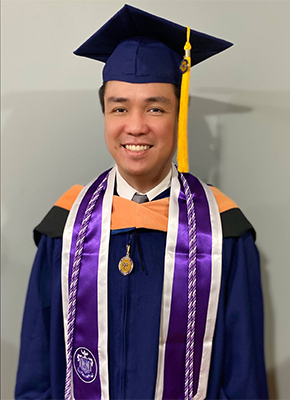
Going into his college years, he knew he wanted a future in healthcare but wasn’t sure about nursing yet. He completed his undergraduate degree in pharmacy, but on a trip to the United States in 2005 he saw firsthand what he terms as, “the vast potential of how it is to be a nurse in the United States.” Back in the Philippines, he returned to school, earning his Bachelor of Science in Nursing in 2008. He emerged as class valedictorian and received a clinical competence award. His career path began as a medical-surgical nurse in his home country, but he later moved to the United States chasing a career in long-term care with an eventual promotion into wound care through a close mentor.
Both caring for wounds and mentoring others deeply resonated with Alex. He now works as a Wound Ostomy Nurse Clinician at a community hospital in New York. “Skin and wounds are the first things that patients and family members will see; it also has an effect on a person's psychosocial being,” he said. “It gives me a sense of fulfillment seeing a wounded patient, or a patient with a new ostomy, come from being desperate and hopeless, to being discharged and feeling independent, able to perform self-care, and regaining their lost sense of self-confidence. That is very fulfilling.”
Because mentorship is part of what led him to this passion, he loves to mentor other nurses and always takes on opportunities to support new nurses like he was supported. “I feel their struggles, as I also struggled at one point. Adjusting to the life of being a nurse is hard—and we all need to nurture our new nurses,” said Alex.
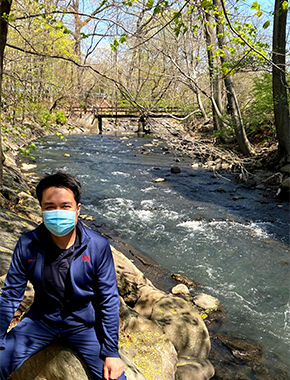
Years of nursing in New York inspired Alex to continue his nursing education. In 2020, he earned an MSN in Nursing Leadership and Management just as COVID-19 began shutting down the world. And in March 2021, he began his journey towards a Doctorate in Nursing for Healthcare Systems Leadership. While earning his master’s degree, Alex was encouraged to apply as a Nurse Leader for his local Sigma chapter and was inducted last year. He quickly involved himself with the Sigma community, citing his excitement to further involve himself in professional networking, volunteering, and scholarship activities. His love for the nursing community is apparent through his philosophy of investing in individual nurses and the field as a whole. “[Nurses] are the heart of healthcare. They are the first and last contact of patients and families,” said Alex. “They keep the whole system connected.”
It’s clear that the further Alex goes into his nursing career and the more accolades he achieves, the more his passion for the profession shines. He hopes to continue his current trajectory in wound care with sights on future opportunities for leadership and education. His message to other nurses and Sigma members is this: “The hardest thing is to start on a new goal or a new dream. The toughest part is to leave your comfort zone and cross the point of no return. But once you do, always aim for the best, give it your best, and do your best. Sigma is here to support you to become the best nurse you can be.”
Alex Aningalan, MSN, RN, CWON, WCC, DAPWCA, FACCWS, is Wound and Ostomy Nurse Clinician at a community hospital in New York. He is a member of Sigma's Phi Pi Chapter in North America.
8/30/2021
Alex Aningalan
MSN, RN, CWON, WCC, DAPWCA, FACCWS
https://thecircle.sigmanursing.org/network/members/profile?UserKey=3ea8f56c-8160-4780-888c-db49439d0c77
4bb28399-46f8-6225-bce7-ff000034804e
AlexFeatureImage
/images/default-source/Member-Stories/alexfeatureimage
alexfeatureimage
https://nursingcentered.sigmanursing.org/images/default-source/member-stories/alexfeatureimage.png?sfvrsn=fa4ae1f2_0
https://nursingcentered.sigmanursing.org/images/default-source/member-stories/alexfeatureimage.tmb-.png?sfvrsn=fa4ae1f2_0
AlexFeatureImage
4bb28399-46f8-6225-bce7-ff000034804e
AlexFeatureImage
/images/default-source/Member-Stories/alexfeatureimage
alexfeatureimage
https://nursingcentered.sigmanursing.org/images/default-source/member-stories/alexfeatureimage.png?sfvrsn=fa4ae1f2_0
https://nursingcentered.sigmanursing.org/images/default-source/member-stories/alexfeatureimage.tmb-.png?sfvrsn=fa4ae1f2_0
AlexFeatureImage
6f058399-46f8-6225-bce7-ff000034804e
Coordination, care, and commitment to research
/juliana-marquezi-pereira
juliana-marquezi-pereira
Sigma member Juliana Marquezi Pereira, BSN, RN, leads the first liver transplant group in Brazil’s largest public health system—and she’s changing lives daily.
Sigma member Juliana Marquezi Pereira, BSN, RN, says she found her career path by chance. She always thought she wanted to be a diplomat, so she studied politics, international law, and languages. But the need to take care of people close to her made her think how much she could help them and make a difference in everyone's life.
After three years studying history and geography at a public college, Juliana realized she needed a change. After passing the vestibular for nursing—an exam necessary to get into a college or university in Brazil—she started her bachelor's degree in 2007 and graduated in 2011.
.jpg?sfvrsn=7bfde1f2_0 "Part of the Nurse Team (CNA, BSN)")
But then her godmother needed an oncological treatment that they didn't have in their rural city in the State of São Paulo, so Juliana’s family moved to São Paulo City. At the same time, she read a report in a newspaper about upcoming intestinal and multivisceral transplants in Brazil that sparked her interest. She researched and found a multidisciplinary specialization in donation, harvesting, and transplantation of organs and tissues at one of the hospitals qualified to perform that type of transplant. While working on her year of specialization, Juliana was awarded a scholarship and started as an intern at the organ transplant ward at Hospital Israelita Albert Einstein in São Paulo which soon led to a full-time job.
Four years after, Juliana was invited to become the Leader of Coordinators and Nursing Liver and Digestive Organs Transplantation, the first liver transplant group in Brazil. It’s the group’s responsibility to plan, manage, monitor, and guide all patients who are enrolled on a liver, pancreas, intestine, and multivisceral transplant list. In addition, they conduct the transplant logistics when there is a donor—confirming data at the Transplant Center and from the donor and recipient surgery along with summoning the patient and the entire team that will work on the surgery.
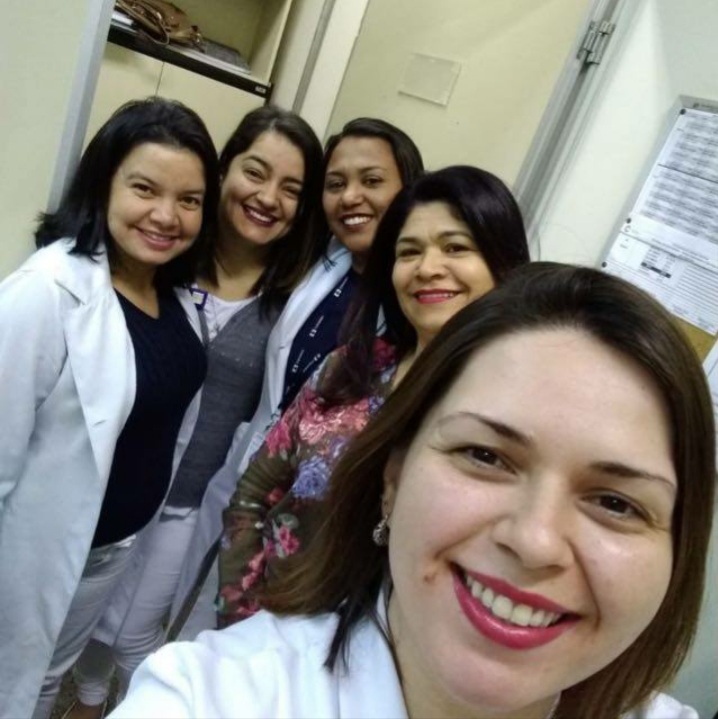
Working in the largest Brazilian public hospital complex, Juliana is often exposed to new discoveries and rare and difficult cases, which has inspired her to study and research more to improve outcomes for her patients. Recently, her transplant team performed the first uterus transplant in Latin America. The recipient went on to give birth to the first baby ever carried by a uterus transplanted from a deceased donor!
Juliana Marquezi Pereira, BSN, RN, is a Clinical Transport Coordinator in Brazil’s biggest public hospital in São Paulo. She is a member of Sigma’s Rho Upsilon Chapter at the University of São Paulo in Brazil, and she is currently working on an Executive MBA in Health Management along with preparing for her master’s degree in nursing.
7/30/2021
Juliana Marquezi Pereira
BSN, RN
29118399-46f8-6225-bce7-ff000034804e
Juliana Marquezi Pereira social graphics_NC Feature 1 (1)
/images/default-source/RNL-Features/vol47/Q3/juliana-marquezi-pereira-social-graphics_nc-feature-1-(1)
juliana-marquezi-pereira-social-graphics_nc-feature-1-(1)
https://nursingcentered.sigmanursing.org/images/default-source/rnl-features/vol47/q3/juliana-marquezi-pereira-social-graphics_nc-feature-1-(1).png?sfvrsn=98e9e1f2_0
https://nursingcentered.sigmanursing.org/images/default-source/rnl-features/vol47/q3/juliana-marquezi-pereira-social-graphics_nc-feature-1-(1).tmb-.png?sfvrsn=98e9e1f2_0
Juliana Marquezi Pereira social graphics_NC Feature 1 (1)
29118399-46f8-6225-bce7-ff000034804e
Juliana Marquezi Pereira social graphics_NC Feature 1 (1)
/images/default-source/RNL-Features/vol47/Q3/juliana-marquezi-pereira-social-graphics_nc-feature-1-(1)
juliana-marquezi-pereira-social-graphics_nc-feature-1-(1)
https://nursingcentered.sigmanursing.org/images/default-source/rnl-features/vol47/q3/juliana-marquezi-pereira-social-graphics_nc-feature-1-(1).png?sfvrsn=98e9e1f2_0
https://nursingcentered.sigmanursing.org/images/default-source/rnl-features/vol47/q3/juliana-marquezi-pereira-social-graphics_nc-feature-1-(1).tmb-.png?sfvrsn=98e9e1f2_0
Juliana Marquezi Pereira social graphics_NC Feature 1 (1)
74df8299-46f8-6225-bce7-ff000034804e
Write, contribute, mentor, repeat
/barre
barre
Nura’s experiences working in more than 20 units in two different countries over 20 years elevated her leadership skills
Nura Barre, ADON, BSN, MLP, was six years old when she made her first nurse’s cap out of a small sheet of white paper and red crayon. She drew a crescent, folded it in a triangle, and stuck it her hair with two little black pincers. She proudly toured the house showing off the masterpiece to her family heralding how she would become the next Florence Nightingale. “It was my dream to become a nurse, as I had two older sisters who were nurses and I used to look up to them.”
Sixteen years following that proud moment, her nursing journey began at a maternity child hospital in a busy pediatric medical unit. From there she rotated for couple of years in different units until she landed in the operating theater (room). Following these fruitful years, she worked as a nursing attendant and went on to get her license and succeeded. She worked as RN for the first time at Rockyview General Hospital, where she gained a whole different experience in the cardiac telemetry unit and grew exponentially. She moved around to two more locations then spent three years at Peter Lougheed Medical Center as the permanent charge nurse in a busy telemetry unit. Then, she received her BSN and master’s degree in leadership and management in education. She stayed in the United Arab Emirates (UAE) for another seven years and worked in three different hospitals focusing on nursing management. Barre is working toward her PhD in nursing.
Over the years, Barre has discovered that the key to achieving better nursing care is getting to know patients through good nursing assessment and proper history taking. “A little bit of compassion and kindness can go a long way and put our fellow humans at ease.”
She genuinely enjoys her current position in leadership and management. “I am so glad when my colleagues come to me for advice trusting my experience and judgment.” Her passion is conflict management and resolution. “I believe that working in close to nine institutions and more than 20 units in two different countries over 20 years has elevated my problem solving abilities and helped my people management skills.”
Barre first heard about Sigma from her professor, Ms. Priyalatha at the Ras Alkhaima Medical & Health Sciences University. “She used to speak about Sigma with passion and respect. I couldn't be more honored to join this reputable organization where nurse leaders meet, contribute, and mentor.”
One of Barre’s strongest assets is policy writing. She has written, contributed, and reviewed many policies in different institutions throughout her career. She has managed many nursing and non-nursing projects where health and wellness of particular society is targeted. She is looking forward to enhancing her research skills and contributing more articles.
Nura Barre, ADON, BSN, MLP, is the duty manager at Mediclinic ME in Abu Dhabi, United Arab Emirates. She is a member of Sigma’s Psi Kappa Chapter in the Middle East.
7/20/2021
Nura Barre
ADON
01c98299-46f8-6225-bce7-ff000034804e
NuraBarre_FeatureImage
/images/default-source/Member-Stories/nurabarre_featureimage
nurabarre_featureimage
https://nursingcentered.sigmanursing.org/images/default-source/member-stories/nurabarre_featureimage.png?sfvrsn=4030e0f2_0
https://nursingcentered.sigmanursing.org/images/default-source/member-stories/nurabarre_featureimage.tmb-.png?sfvrsn=4030e0f2_0
NuraBarre_FeatureImage
01c98299-46f8-6225-bce7-ff000034804e
NuraBarre_FeatureImage
/images/default-source/Member-Stories/nurabarre_featureimage
nurabarre_featureimage
https://nursingcentered.sigmanursing.org/images/default-source/member-stories/nurabarre_featureimage.png?sfvrsn=4030e0f2_0
https://nursingcentered.sigmanursing.org/images/default-source/member-stories/nurabarre_featureimage.tmb-.png?sfvrsn=4030e0f2_0
NuraBarre_FeatureImage
100b8099-46f8-6225-bce7-ff000034804e
Am I not enough?
/simon-paul-navarro
simon-paul-navarro
We all have moments of feeling helpless, but Sigma member Simon Paul P. Navarro, BSN, RN, believes being present is something to be proud of.
 Growing up in the Philippines and having family ties to the nursing profession, Sigma member Simon Paul P. Navarro, BSN, RN, always knew that nursing was the career for him. Seeing his families’ caring attitude and compassion for helping others inspired him to follow in their footsteps.
Like so many growing up in a low-income country, he dreamed of being able to help his family financially while also providing hope to strangers. But what he found out was far from the picture he had painted in his head.
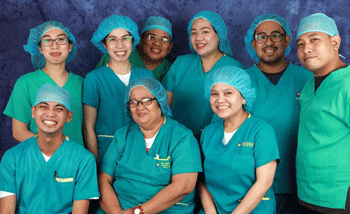 “Filipino nurses in the country, we’re working beyond the ideal shifting cycles or hours, handling different types of patients inappropriate to the number of nurses available, and getting non-competitive salaries. These working conditions are not standard and beyond the international recommendation in the nursing practice.”
To help maintain his sanity, provide the best care possible to patients, and also deal with the many stresses of the job, Simon searched for a self-care solution. Knowing he needed some time for himself to restart and recharge, he found healing in traveling.
“Offering yourself to someone who’s sick and taking care of them drains you as an individual person and human-being. It’s a hard truth and fact that our job as nurses is an exhausting one. We are knowledge workers who are vulnerable to mental fatigue. And with that, we need to find ways to recuperate ourselves from the toxicities brought by our profession.”
Witnessing first-hand different cultures and traditions have enhanced his core values as a nurse—respect for others, being kind, and showing empathy. But when COVID-19 struck the world, Simon’s ability to take care of his own mental health was challenged. All travel came to a halt and he had to find new ways to manage the physical and emotional challenges that cause him stress.
 For the first time in his professional career, he struggles with feeling helpless. “Seeing someone in pain or feeling miserable and knowing there’s nothing you can do to help our patients during this pandemic is the most difficult thing I deal with. I am a nurse because I genuinely care about people and want to help them to restore their health; but when I can’t do anything because of uncertainties brought on by this condition, that’s really hard. Sometimes I’ll just ask myself mentally, ‘Am I not enough?’ or ‘Where was I lacking?’”
While he is still finding ways to cope and find his “new normal,” he is certain that there will be a time to travel and resume the life that COVID-19 has currently taken from us.
“As nurses, we have our own definition of success, which are manifested by various accomplishments in our personal and professional life. However, I do believe that being present in the nursing profession during this time of pandemic, either clinical or non-clinical, is the best accomplishment for us nurses to be proud of. Kudos to all of us healthcare providers.”
Simon Paul P. Navarro, BSN, RN, currently works as a full-time surgical ICU nurse and is finishing his master’s degree in nursing at the University of the Philippines. He is also a part-time nursing faculty member teaching health assessment, nursing pharmacology, and medical-surgical nursing to students enrolled in the BSN program. He is a proud member of both Sigma’s Psi Beta and Nu Beta at-Large chapters. We are grateful for his commitment as a volunteer on Sigma’s International Nurse Leader Review Committee, where he checks and evaluates Sigma membership applications of nurses worldwide.
4/9/2021
Simon Paul P. Navarro
BSN, RN
d6b78099-46f8-6225-bce7-ff000034804e
Simon Paul Navarro Feature Image
/images/default-source/RNL-Features/vol47/Q2/simon-paul-navarro-feature-image
simon-paul-navarro-feature-image
https://nursingcentered.sigmanursing.org/images/default-source/rnl-features/vol47/q2/simon-paul-navarro-feature-image.png?sfvrsn=774fe2f2_0
https://nursingcentered.sigmanursing.org/images/default-source/rnl-features/vol47/q2/simon-paul-navarro-feature-image.tmb-.png?sfvrsn=774fe2f2_0
Simon Paul Navarro Feature Image
d6b78099-46f8-6225-bce7-ff000034804e
Simon Paul Navarro Feature Image
/images/default-source/RNL-Features/vol47/Q2/simon-paul-navarro-feature-image
simon-paul-navarro-feature-image
https://nursingcentered.sigmanursing.org/images/default-source/rnl-features/vol47/q2/simon-paul-navarro-feature-image.png?sfvrsn=774fe2f2_0
https://nursingcentered.sigmanursing.org/images/default-source/rnl-features/vol47/q2/simon-paul-navarro-feature-image.tmb-.png?sfvrsn=774fe2f2_0
Simon Paul Navarro Feature Image
61287399-46f8-6225-bce7-ff000034804e
The class of 2020
/marthalynn-rodriguez
marthalynn-rodriguez
Marthalynn Rodriguez finished her final semester like many students—virtually—because of the COVID-19 pandemic.
Marthalynn Rodriguez, BSN, RN, is a new graduate and member of Sigma’s Pi Gamma Chapter. She finished her final semester like many students—virtually—because of the COVID-19 pandemic. In August, she will begin her residency in the Adult ICU of Northside Hospital in Atlanta, Georgia, USA.
“Like many parents right now, I find myself in the role of teacher, facilitator, coach, and motivator for my children’s education,” she said. “My routine these days consists of mathematics, language arts, foreign language, and STEM activities with my first and fourth graders. Luckily, I had completed most of my clinical hours prior to the pandemic, so other than my nursing lectures and exams moving to an online format, my schooling didn’t change too much. I am being intentional about taking time to spend in nature, bond with my family, and help others in my community.”
Marthalynn’s greatest challenge right now is that she misses the connection she had with her classmates and professors. They had no idea the last time they were together in class that they may not see each other again. “Not being able to say a proper goodbye or to mark our transition into nursing has been difficult.”
In 2000, Marthalynn graduated with a degree in Human Resources and Human Services. Then she worked as a medical assistant for 10 years. After her first child was born, she became a stay-at-home parent. After her youngest entered kindergarten, she started to pursue her dream of becoming a registered nurse. Her dream stems from the births of her children and her parents’ deaths, she said. They “highlighted the profound role of nurses in both ushering in life, navigating a respectful death, and everything in between. I knew I wanted to play a role where I would have such an important impact in people’s lives.” She finds the most enjoyable part of nursing is working with a talented and intelligent team of professions sharing the common goal of providing patients with the very best care.
Since joining Sigma in 2019, she has served as a Student Leadership Intern for the Pi Gamma Chapter and will serve on the chapter’s Student Engagement Committee in the coming year. Marthalynn attended the 45th Biennial Conference in November 2019. It showed her the many contributions Sigma nurses make all over the world. She is excited to follow in their footsteps. To sum up her Sigma experience so far, she said, “I have been inspired to reach higher and to continue setting career goals even as I achieve them.”
Congratulations, Class of 2020!
5/13/2020
Marthalynn Rodriguez
BSN, RN
4e287399-46f8-6225-bce7-ff000034804e
Marthalynn-Rodriguez_web
/images/default-source/Member-Stories/marthalynn-rodriguez_web
marthalynn-rodriguez_web
https://nursingcentered.sigmanursing.org/images/default-source/member-stories/marthalynn-rodriguez_web?sfvrsn=ffd011f2_0&download=true
https://nursingcentered.sigmanursing.org/images/default-source/member-stories/marthalynn-rodriguez_web.tmb-.png?sfvrsn=ffd011f2_0
Marthalynn Rodriguez
4e287399-46f8-6225-bce7-ff000034804e
Marthalynn-Rodriguez_web
/images/default-source/Member-Stories/marthalynn-rodriguez_web
marthalynn-rodriguez_web
https://nursingcentered.sigmanursing.org/images/default-source/member-stories/marthalynn-rodriguez_web?sfvrsn=ffd011f2_0&download=true
https://nursingcentered.sigmanursing.org/images/default-source/member-stories/marthalynn-rodriguez_web.tmb-.png?sfvrsn=ffd011f2_0
Marthalynn Rodriguez
bacf7299-46f8-6225-bce7-ff000034804e
Persevering through a pandemic
/amisha-parekh-de-campos
amisha-parekh-de-campos
Amisha Parekh de Campos PhD, MPH, RN, CHPN, is a nurse researcher, leader, and clinician, who has, like so many others, been professionally affected by the COVID-19 pandemic.
Amisha Parekh de Campos PhD, MPH, RN, CHPN, is a nurse researcher, leader, and clinician, who has, like so many others, been professionally affected by the COVID-19 pandemic.
Nursing was a second career for Amisha. She started working in public health as a program planner and advisor, but she missed the firsthand experience of directly working with people and went back to school for her BSN. She spent a year in a neuro-trauma setting, gaining valuable acute care experience, before moving on to palliative and hospice homecare.
“I am incredibly passionate about the work that I do in palliative and hospice care. Not only do I have the opportunity to care for patients during a critical time in their lives, but I am also able to be a leader and mentor to new nurses, and advocate for this profession. I look forward to using my experience to teach nurses starting in the profession and hopefully instill in them the same passion and drive,” she said.
Her nursing practice has changed dramatically since the pandemic began. She has been asked to help with COVID positive and suspected COVID patients—a significant shift to directly working with rapidly deteriorating patients. Over the years, she has worked in many roles in a hospice homecare program, including field nurse, community liaison, supervisor, and now, as quality and education coordinator. Now, she works several evenings a week on top of her current role, assisting with these very ill patients because of staff shortages. “I am grateful to be able to provide care and support to these patients when their loved one cannot be present,” Amish said. “It has been a quick transition as changes on recommendations and declines among patients were so rapid, but the team of healthcare clinicians I work with is incredible and inspiring.”
As a mother to a 6- and 8-year-old, one of her greatest challenges is balancing work, school, and home life. She feels an obligation to help as a nurse during this time, but her biggest fear is infecting her family. “To help our home situation,” she said, “I sleep on a different floor and try not to share too many household items with the rest of the family. It has been hard not being able to hug and touch my kids constantly, but I am glad I can contribute to care for these very ill patients.”
The COVID-19 pandemic has also influenced Amisha’s research in advance care planning and communication. “Now more than ever,” she said, “conversations about end-of-life goals and preferences are imperative. The fast pace of the virus among the elderly has shown how important it is to have advance care planning discussion early and often.” She successfully defended on 20 April 2020 and now holds a PhD in nursing. She has been member of Sigma’s Mu Chapter for 10 years.
Amisha joined Sigma because she heard about Sigma’s member benefits—networking, resources, and educational opportunities—but found much more. She also “found a sense of camaraderie and cohesiveness among Sigma nurses.” At the 45th Biennial Convention she presented her research. “Meeting nurses from around the world, discussing programs of research and collaborating was a unique and unforgettable experience. There is a certain sense of pride being among all these accomplished nurses who strive to enhance the profession.”
As she continues to persevere through the COVID-19 pandemic, Amisha looks forward to continuing to work in palliative and hospice care as well as teaching and inspiring the same passion and drive she has in new nurses.
5/1/2020
Amisha Parekh de Campos
PhD, MPH, RN, CHPN
4bcf7299-46f8-6225-bce7-ff000034804e
Amisha-Parekh-de-Campos_web
/images/default-source/Member-Stories/amisha-parekh-de-campos_web
amisha-parekh-de-campos_web
https://nursingcentered.sigmanursing.org/images/default-source/member-stories/amisha-parekh-de-campos_web?sfvrsn=fa3710f2_0&download=true
https://nursingcentered.sigmanursing.org/images/default-source/member-stories/amisha-parekh-de-campos_web.tmb-.png?sfvrsn=fa3710f2_0
Amisha Parekh de Campos
4bcf7299-46f8-6225-bce7-ff000034804e
Amisha-Parekh-de-Campos_web
/images/default-source/Member-Stories/amisha-parekh-de-campos_web
amisha-parekh-de-campos_web
https://nursingcentered.sigmanursing.org/images/default-source/member-stories/amisha-parekh-de-campos_web?sfvrsn=fa3710f2_0&download=true
https://nursingcentered.sigmanursing.org/images/default-source/member-stories/amisha-parekh-de-campos_web.tmb-.png?sfvrsn=fa3710f2_0
Amisha Parekh de Campos
245c7299-46f8-6225-bce7-ff000034804e
Finding connection during a crisis
/danielle-langkaas
danielle-langkaas
Sigma member finds that now more than ever coworkers can be like family.
Connection is the key to Danielle Langkaas, BScN, RN. She became a nurse and nurse educator because she liked connecting with people and was interested in the medical field. “I thrive on human connection and specifically being a part of people’s lives during the best and worst times,” she says.
Now, more than ever, she is finding that connection with her coworkers. Danielle is a nurse educator as well as frontline staff. She is a nurse educator resource faculty member at MacEwan University, where she has been assisting other nurse educators who are continuing courses via virtual simulation as well as collaborating with the leadership team to address tasks and concerns related to the COVID-19 pandemic. Nurse educators now assist theory faculty on marking assignments, while theory faculty create online versions of their courses. Danielle and her colleagues have also set up virtual meetings for work and for socializing purposes with different themes and agendas. She’s on the frontlines as an emergency nurse in two emergency departments—at Misericordia Hospital Emergency Department and Northern Lights Regional Health Centre—and is assisting with normal frontline duties as well as screening for all hospital staff.
Her advice to nurses is, “This is a time where you realize that your coworkers can sometimes be more like your family. Continue to work together and stay safe!”
Danielle started as a research assistant in hematology research and then a study coordinator role. After she received her RN and BScN programs, she found her passion in frontline clinical nursing in an emergency setting. She spent three years at a hospital in Fort McMurray, Alberta, Canada, and was trained for resuscitation/acute patient assignment, triage, and the charge role. She served as an emergency nurse on the team, in 2016, when wildfires caused the whole city to evacuate—the largest wildfire and subsequent evacuation in Canada’s history—and spent the month after working on disaster relief efforts.
After knee surgery, Danielle was off for six months. A poor recovery meant she needed a position that was a little less physically demanding. That’s when she found another passion—post-secondary nursing education at MacEwan University in Edmonton, Alberta, Canada. She began as a clinical nurse educator and has since moved to a resource faculty role. “I love that I engage in many different roles as an RN from being a frontline critical care clinician, an educator and resource for undergraduate nursing students and faculty, and can also pursue global volunteering opportunities,” she says.
During her first year of teaching, she found out about Sigma and joined for networking purposes as she transitioned from clinician to educator. In the past year and a half of membership, she has been president-elect and now president of Sigma’s Chi Nu Chapter. She has found that membership has given her options for postgraduate programs, connected her to professionals all over the world, and enhanced her leadership skills. Recently, her Sigma membership led her to go on a medical mission trip to Uganda, Africa, because of a strategic partnership with her chapter.
4/14/2020
Danielle Langkaas
BScN, RN
115c7299-46f8-6225-bce7-ff000034804e
591x476_Danielle-Langkaas
/images/default-source/Member-Stories/591x476_danielle-langkaas
591x476_danielle-langkaas
https://nursingcentered.sigmanursing.org/images/default-source/member-stories/591x476_danielle-langkaas.jpg?sfvrsn=b0a410f2_0
https://nursingcentered.sigmanursing.org/images/default-source/member-stories/591x476_danielle-langkaas.tmb-.jpg?sfvrsn=b0a410f2_0
Danielle Langkaas
115c7299-46f8-6225-bce7-ff000034804e
591x476_Danielle-Langkaas
/images/default-source/Member-Stories/591x476_danielle-langkaas
591x476_danielle-langkaas
https://nursingcentered.sigmanursing.org/images/default-source/member-stories/591x476_danielle-langkaas.jpg?sfvrsn=b0a410f2_0
https://nursingcentered.sigmanursing.org/images/default-source/member-stories/591x476_danielle-langkaas.tmb-.jpg?sfvrsn=b0a410f2_0
Danielle Langkaas
f08d6d99-46f8-6225-bce7-ff000034804e
Trusting the journey
/moishe-ragieme
moishe-ragieme
Sigma nurse educator and leader Moishe Ragieme has faced many obstacles and hardships throughout his life and career but proves it’s the journey that teaches the most.
Many journeys, especially those specific to life and career, seem as though they should be a straight shot. More often than not, we find this not to be the case. Sometimes, the twists, turns, and total derailments offer something better; a true purpose.
Sigma member Moishe Ragieme, MSNEd, RN, has been a nurse for the past 24 years, and though he’s always wanted to be involved in the medical field, he initially did not consider nursing. “I’ve wanted to be a doctor ever since I can remember; since about five years old or so,” says Moishe. “There were several life experiences that brought nursing to the forefront for me, though, and I remain passionate about my involvement to this day.”
Born in Beirut, Lebanon, Moishe faced many obstacles and trials, all of which he’d eventually overcome. The lessons he learned and experiences he’d faced during these hardships stayed with him and guided his path, both in his career and life.
After the passing of his wife, Moishe had become the primary support and parent for his two children, the eldest of whom had been battling cystic fibrosis from a young age. He also stepped into the role as her primary caregiver, again feeling called to enter the medical field. But this time, he considered nursing. “We’d visit different facilities and my daughter would get great care at some while receiving poor care at others, and I realized I could have done just as good of a job or better. She once told me that I had given her the best care of anyone [who has treated her] and that she would love to see me consider nursing as a profession,” he says. Eventually, Moishe’s eldest daughter contracted pneumonia and succumbed to her disease, but that piece of advice that she gave her father turned out to be something precious and remains as his compass throughout his career.
Moishe enrolled in school to study nursing and earned a critical care internship in a surgical intensive care unit (ICU). After a couple of years, he earned a position in an emergency department and knew he had finally found his path in emergency nursing. Since then, Moishe has expanded his passions to include guiding the next generation of emergency department nurses through nursing education. In addition to working in a local hospital’s emergency department, he is also currently a clinical nurse education faculty member for both St. Anselm College and the Salter School of Nursing, Manchester, New Hampshire, USA. He teaches a variety of subjects, including medical Spanish for health professionals, advanced cardiovascular life support (ACLS), and pediatric advanced life support (PALS), always using his clinical experiences to ensure the message sticks with his students. “[Teaching] is a great choice for me, as I have been able to impart my passion for nursing to the next generation of nursing students. My students consistently tell me that my teaching methods make their understanding clearer, simplified, and more permanent.”
Although his passion for nursing and clinical nursing education is a strong force in his life and keeps him busy, Moishe has also been able to devote some time to another great passion of his: creating fused glass art pieces. He is currently co-owner of Monte Verde Art Glass Studio, LLC, a studio that offers different functional art pieces for the home, in addition to leading classes, bringing the art of fused glass to others while sharing his knowledge of the process and the medium he works in.
“I use my joy of artistry in glass as a way to re-center myself, especially if I’ve had hard experiences in the emergency room,” he says. “What is great about this medium is that you can manipulate it to your own specifications and create a truly unique expression of yourself.”
In looking toward the future, Moishe’s path again remains uncertain, as he’s decided to add a new position in the emergency department to his current rotation of teaching classes and developing the next generation of nurse leaders. He’s approaching the opportunity with some trepidation, but it’s not enough to deter him. “Many nurses experience those same feelings when they go into a new situation,” he says. “You hope to still be able to prove your worth and remember all the lessons from your previous experiences. That’s what my future holds: teach nurses, both young and experienced, to work together as teammates and let their experiences through life act as their guide.”
10/7/2019
Moishe Ragieme
MSNEd, RN
d78d6d99-46f8-6225-bce7-ff000034804e
Nurse Educator Moishe Ragieme
/images/default-source/Member-Stories/nurse-educator-moishe-ragieme
nurse-educator-moishe-ragieme
https://nursingcentered.sigmanursing.org/images/default-source/member-stories/moishe-ragieme_591x476.jpg?sfvrsn=76750ff2_0
https://nursingcentered.sigmanursing.org/images/default-source/member-stories/moishe-ragieme_591x476.tmb-.jpg?sfvrsn=76750ff2_0
Photo of nurse educator Moishe Ragieme
d78d6d99-46f8-6225-bce7-ff000034804e
Nurse Educator Moishe Ragieme
/images/default-source/Member-Stories/nurse-educator-moishe-ragieme
nurse-educator-moishe-ragieme
https://nursingcentered.sigmanursing.org/images/default-source/member-stories/moishe-ragieme_591x476.jpg?sfvrsn=76750ff2_0
https://nursingcentered.sigmanursing.org/images/default-source/member-stories/moishe-ragieme_591x476.tmb-.jpg?sfvrsn=76750ff2_0
Photo of nurse educator Moishe Ragieme
a97c6d99-46f8-6225-bce7-ff000034804e
Building a community of student leaders
/george-williams-chale-pool
george-williams-chale-pool
Sigma member George Williams Chale Pool cultivates a robust community of nurse leaders on his campus by using social media tactics and member resources.
The power of social media has played a significant role for George Chale Pool, a Sigma member and nursing intern in Mexico. It was just a few months ago when Pool discovered Sigma on social media channels. He quickly realized he had a deep interest in the organization and wanted to connect with other nurse leaders.
With a passion for helping others and improving global health, Pool felt called to the field. He enrolled in nursing school and quickly realized he could help the university reach new heights by offering additional resources to nursing students. Specifically, he wanted to bring leadership development opportunities to his campus. He relied heavily on his Sigma membership and the provided tools to start cultivating a robust community of student nurses who wanted to excel beyond the classroom.
His interest in global initiatives and nursing excellence served as a platform to propel his peers to a path of success. Pool made a decision that ultimately changed his university’s nursing program forever. Inspired by Sigma’s mission and his own personal values, he founded the Mexican Nursing Students Association (MNSA) .
Combined with his commitment to advancing student nurses and smart social media tactics, Pool has seen a significant interest about MNSA. Through his dedication to student nurse leadership and the new-found association, he has been fortunate to see, firsthand, the major developments and advancements in extracurricular involvement on his campus. The success stories of his peers have been one of the most rewarding parts of his academic career.
In addition to his role as MNSA’s president, his Sigma membership, and dedicating time to his studies and internship, Pool finds the time to serve his community as a youth ambassador of My World Mexico and a supporter of Nursing Now.
10/1/2019
George Williams Chale Pool
Undergraduate Student
f5776d99-46f8-6225-bce7-ff000034804e
George-Chale-Pool
/images/default-source/Member-Stories/george-chale-pool
george-chale-pool
https://nursingcentered.sigmanursing.org/images/default-source/member-stories/george-chale-pool.jpg?sfvrsn=558f0ff2_0
https://nursingcentered.sigmanursing.org/images/default-source/member-stories/george-chale-pool.tmb-.jpg?sfvrsn=558f0ff2_0
George-Chale-Pool
f5776d99-46f8-6225-bce7-ff000034804e
George-Chale-Pool
/images/default-source/Member-Stories/george-chale-pool
george-chale-pool
https://nursingcentered.sigmanursing.org/images/default-source/member-stories/george-chale-pool.jpg?sfvrsn=558f0ff2_0
https://nursingcentered.sigmanursing.org/images/default-source/member-stories/george-chale-pool.tmb-.jpg?sfvrsn=558f0ff2_0
George-Chale-Pool
d40f6c99-46f8-6225-bce7-ff000034804e
My nursing ministry: A journey from the heart
/sr.-maurita-soukup
sr.-maurita-soukup
Sigma member Sr. Maurita Soukup connects her faith and her passion in cardiovascular nursing and uses both in her continuous service to others.
Sr. Maurita’ s early life was solidly grounded in faith, family, and friends and the generational traditions, strong work ethic, and caring service to others that reflect on her Iowa upbringing. First graduating from a diploma nursing program and gaining experience as a critical care RN, she discerned a calling to religious life. Inspired by the Sisters of Mercy and their fourth vow of service and its charism of mercy to “God’s dear poor,” Sr. Maurita related that the Foundress of the Sisters of Mercy in Ireland, Catherine McAuley had exchanges with Florence Nightingale. Comprehending and integrating these interconnections into a life-ministry construct compelled her to a greater life purpose.
In this way and for many, nursing was both a profession and a ministry, or way of ministering. Sister found her early passion in critical care and became a highly regarded expert in cardiovascular nursing. Her string of credentials is, at times, a source of conversation. To Sister Maurita, each has its own story, complete with learning opportunities with outstanding professors, state-of-the discipline that did not recognize credit transfers from one program to another, and opportunities to learn from interdisciplinary scholars who had their own lens on scientific rigor, research methods, critical thinking, and an exposure to varied theories, such as systems thinking.
A native of Cedar Rapids, Iowa, Sister Maurita earned her diploma in 1964 at Mercy School of Nursing in Cedar Rapids and a BS degree in biology in 1970 at Mount Mercy College. Three years later at Marycrest College in Davenport, she earned her BSN, followed by her MSN at the University of Alabama-Birmingham in 1975. It was in 1989 that she completed her DNSc (later reclassified as a PhD) from the Catholic University of America in Washington, DC. Just this year, she was awarded an honorary doctorate in human letters from Creighton University in Omaha, Nebraska.
In her more than 50 years of ministry, she held critical care nursing positions in a number of Midwest hospitals; she served as adjunct faculty at several universities. Career highlights include co-founding the open-heart program for the city of Cedar Rapids, becoming the Founding Director of the Eastern Iowa Heart Institute, inaugurating the Center for Advanced Nursing Practice at Bryan LGH Medical Center, followed by opportunities as a Critical Care Clinical Nurse Specialist at the Iowa Health Hospital at Mercy Medical Center and Vice President of The Iowa Heart Hospital, both in Des Moines, Iowa. Each position was graced with energy, state-of-the-art knowledge generation and commitment to the rapid uptake of best practices, and analytic approaches to improve the patient experience.
Life commitments to caring for her family in Cedar Rapids opened a new door for Sister Maurita. At this juncture she undertook special health projects and ministries linked to her religious order, used her research and consultant expertise for system-level health systems, and co-ministered to individuals and families during the epic flood of 2008.
In the past decade Sister Maurita has used her accumulated knowledge, skills, and abilities to serve in board governance positions ― she holds positions on the boards of MercyOne-Mercy Medical Center in Sioux City, Mercy Medical Center in Mason City, Mercy Hospital New Hampton, Mercy Medical Center Des Moines, and Mercy Medical Center Cedar Rapids. Beyond hospital-based boards, Sister serves on the Board of Mercy College of Health Sciences and regional boards for MercyOne Iowa and Nebraska Trinity Regional Health System in Des Moines and Common Spirit (formerly CHI) CHI-Health NE/IA System in Omaha, NE. What links these divergent board roles?
“As a board member, my contributions always center on the board governance and its respective responsibilities, including its roles in delivering exceptional patient care. I address issues of human values rooted in mission, the meaningful use of information technology to drive decision-making, a healthy work environment, and ensure that professionals are accountable for practice.” Sister reflects, “Nurses on Boards are not limited to their patient care perspective ― that is a grounding for the perspective that nurses bring to the board, but as a board member I continuously reflect that my role and contributions are beyond operations. It is to ensure that the mission is lived and harmonized with the overall clinical and fiscal health of the organization and to build a preferred future for what is needed in the changing needs within communities and beyond.” To this end, Sister Maurita is frequently appointed to board committees such as quality and safety, finance, ethics, compliance, audit, credentialing, and strategic planning.
Sr. Maurita claims that her involvement in nursing’s professional organizations have been instrumental in her readiness to assume responsibilities on boards. Her involvement with Sigma in particular began in 1975, when Sr. Maurita was inducted into Sigma’s Nu Chapter at the University of Birmingham. Entrusted with carrying out its mission to support learning, knowledge, and professional development, Sigma led with a global orientation to influence universal health. Sister’s ministry from and for the heart was advanced as a Cardiovascular Clinical Nurse Specialist, where she applied the CNS roles as practitioner, researcher, educator, administrator, and change agent in various positions within and external to Mercy-based organizations. Wherever she resided, she remained steadfast to local Sigma chapters, particularly by supporting the scholarly endeavors of peers and upcoming leaders. She notes, “[Sigma] is a gift to nursing. It creates a community of individuals dedicated to collegial contributions to science, leadership, and practice ― it affirms us all.”
Beyond Sigma, she has participated in and witnessed board functions with the American Association of Critical Care Nurses, the American Organization for Nursing Leadership, the National Organization of Clinical Nurse Specialists, the Iowa Donor Organization, the Iowa Hospital Association, the American Heart Association, and the Catholic Hospital Association. She was the first recipient of the Dr. Teresa Christy Award for integrating practice, education, and research by the Iowa State Nurses Association, named a Nurse Visionary by the University of Alabama-Birmingham, an implementation grant recipient from the Pew Charitable Trust and Robert Wood Johnson Foundation to Redesign Health Care, and the honorary doctorate previously mentioned.
“Life is about using one’s gifts to benefit others. It is equally about accepting the gifts of others. And by gifts, I mean talents, skills, abilities, values, perspectives, and energy.” She concludes with this simple thought: “Nursing is offering mercy to others. Each of us are instruments of healing. I’ve been graced to have found multiple ways to extend this charism of nursing over a career that includes [Sigma]. It is a journey from my heart.”
8/30/2019
Sr. Maurita Soukup
PhD, MSN, BSN, BS, RSM, RN, Alumnus CCRN
d10a6c99-46f8-6225-bce7-ff000034804e
Sr. Maurita and heart
/images/default-source/Member-Stories/sr-maurita-and-heart
sr-maurita-and-heart
https://nursingcentered.sigmanursing.org/images/default-source/member-stories/sr-maurita_591x476_mr.jpg?sfvrsn=70f20ef2_0
https://nursingcentered.sigmanursing.org/images/default-source/member-stories/sr-maurita_591x476_mr.tmb-.jpg?sfvrsn=70f20ef2_0
Sr. Maurita and heart
d10a6c99-46f8-6225-bce7-ff000034804e
Sr. Maurita and heart
/images/default-source/Member-Stories/sr-maurita-and-heart
sr-maurita-and-heart
https://nursingcentered.sigmanursing.org/images/default-source/member-stories/sr-maurita_591x476_mr.jpg?sfvrsn=70f20ef2_0
https://nursingcentered.sigmanursing.org/images/default-source/member-stories/sr-maurita_591x476_mr.tmb-.jpg?sfvrsn=70f20ef2_0
Sr. Maurita and heart
1fb46999-46f8-6225-bce7-ff000034804e
Doing what it takes ... it takes a nurse
/representative-gale-adcock
representative-gale-adcock
North Carolina Representative and Sigma member Gale Adcock shares her leadership journey, the skills nurses bring to the political arena and why she thinks more nurses absolutely belong at the table.
Career opportunities in the field of nursing are invigorating and satisfy a wide array of interests — it’s one of the many reasons why so many talented individuals are drawn to the profession. Those who haven’t spent much time within the field may believe that while the opportunities seem endless, they still firmly reside within the confines of a hospital or an academic institution. In reality, this perception is quite far from the truth.
The skills that nurses use daily and have cultivated throughout their careers can also be applied to a variety of leadership roles, including that of an elected official or a politician. Gale Adcock has been a Sigma member since 1978 (Beta Nu and Alpha Alpha Chapters) and a member of the North Carolina House of Representatives since 2014.
Adcock advocates for the health of her community through her elected service as a state legislator as well as her role as Chief Health Officer at SAS Institute, Inc. and practicing family nurse practitioner (FNP). Driven by the desire to have a more significant impact on health in the broadest sense, Representative Adcock decided that becoming one of the decision-makers was the best way to have a bigger impact on health by setting health policy. “Healthy individuals and families start with healthy communities. Policy decisions made by elected officials determine how healthy a community can ultimately become, so I decided to become one of those elected officials.”
She began her political journey in 2007, the first of two terms on the Cary, NC Town Council. In 2014 she was elected to the North Carolina legislature, where she remains the only advanced practice registered nurse ever to serve. Currently serving her third term representing the 41st House District, she continues to provide the leadership necessary to allow her constituents, and the communities they call home, to be healthy and thriving. As SAS Chief Health Officer, she leads a 58-member team that provides free primary care to 14,000 employees and family members. “It’s a C-level position that involves financial forecasting, managing an annual budget of $7 million, strategic planning, problem solving, negotiation, consensus building, policy-making, and communicating effectively. It also calls for in-depth knowledge of evolving state and national business practices, as well as the health care environments that exist beyond nursing.”
When asked to describe the skill differences between her roles, Representative Adcock described the core skills needed for her multiple positions as “uncannily similar.” “[Core nursing skills] like the ability to listen without judgement, process large amounts of information quickly, make evidence-based decisions and evaluate results are skills I use every day, as a legislator, an FNP, and the Chief Health Officer,” she said. “Nurses are necessarily courageous and resilient. My business experience adds new depth and range to those characteristics but doesn’t replace them or diminish their worth. Twenty-five years in the corporate world have taught me how to create and defend a business case and hold my ground with other strong-willed leaders competing for limited resources.” She continues, “I’ve also had to develop new skills; like campaigning for and holding office as well as acquiring new knowledge in subjects like environmental protection, public education, transportation infrastructure, taxes, and economic development.”
Nurses have much to contribute to leadership roles in any field and doing so can be one of many ways to continue advancing health across the globe. But, nurses have to get involved in order to do so. As for the best way? “Get involved in your professional nursing organization — and then step outside it. Develop relationships and networks beyond nursing and health care — education, the arts, business, philanthropy, etc. It may seem counterintuitive, but nurses need to intentionally step away from the comfort of what we already know, using our core nursing skills but also embracing the chance to learn new ones. This is how we gain power and influence outside the nursing profession. Ultimately, using these tools is how we advance nursing and individual nurses.”
6/21/2019
Representative Gale Adcock
MSN, RN, FNP-BC, FAANP, FAAN
08b46999-46f8-6225-bce7-ff000034804e
Photo of NC Representative Gale Adcock
/images/default-source/Member-Stories/photo-of-nc-representative-gale-adcock
photo-of-nc-representative-gale-adcock
https://nursingcentered.sigmanursing.org/images/default-source/member-stories/adock-gale_591x476_mr.jpg?sfvrsn=b94c0bf2_0
https://nursingcentered.sigmanursing.org/images/default-source/member-stories/adock-gale_591x476_mr.tmb-.jpg?sfvrsn=b94c0bf2_0
Photo of NC Representative Gale Adcock
08b46999-46f8-6225-bce7-ff000034804e
Photo of NC Representative Gale Adcock
/images/default-source/Member-Stories/photo-of-nc-representative-gale-adcock
photo-of-nc-representative-gale-adcock
https://nursingcentered.sigmanursing.org/images/default-source/member-stories/adock-gale_591x476_mr.jpg?sfvrsn=b94c0bf2_0
https://nursingcentered.sigmanursing.org/images/default-source/member-stories/adock-gale_591x476_mr.tmb-.jpg?sfvrsn=b94c0bf2_0
Photo of NC Representative Gale Adcock
f0ee6899-46f8-6225-bce7-ff000034804e
Sowing the seeds of leadership
/logan-webb
logan-webb
Channeling the lessons taught by his grandparents and their garden, Beta Chi Chapter member seeks to cultivate nurses working in Critical Care.
Nursing and gardening—on the surface, neither really seem like they have much to do with the other, but upon digging deeper (pardon the pun), the commonalities start to become abundantly apparent. At least, that’s how it started for Beta Chi Chapter member Logan Webb. Spending a lot of time in the garden with his grandparents, Logan learned to be curious about the world around him. Logan remembers going out into the garden early in the morning, smelling fresh tilled dirt and, over time, watching the seeds they planted sprout and grow. He says, “It was the start of my interest in nature and the life sciences in general.” Along with these initial lessons, Logan’s grandparents also taught him to always be observant and curious, and that continuous learning was a great way to feed that curiosity.
His drive to learn and make the world didn’t stop in his youth. Proving light shines in even the darkest of places, Logan found an outlet for his passion and drive among one of the hardest trials: his grandmother’s diagnosis with Stage IV metastatic breast cancer and her eventual passing. “I felt so helpless; I couldn’t care for my grandmother the way she had cared for me whenever I was sick. After she passed, there was a void inside me and I couldn’t find anything that could fill it”, Logan says. All of that changed though when Logan attended a local program that allowed high school students to shadow various healthcare professionals. Initially attending wanting to become a doctor, Logan was able to get an inside look at the nursing profession, and he was hooked. “I knew that nursing would allow me the opportunity to provide compassionate, evidenced-based care for people who are in the most vulnerable period of life.”
Following his passions and driven by his need to learn, Logan found that while he enjoyed providing solutions within critical care nursing, he still felt the drive to go further. That drive had also earned him an invitation to join Sigma, something Logan aspired to do since his pre-clinical nursing days. Today, Logan is both a Chapter Leader and (the first appointed!) Membership Ambassador for Beta Chi Chapter, where he works to connect new nurses with Sigma, their Chapter, and other nurses with similar interests. “Becoming a member of a designated honor society allows members to network, glean information, offer/receive support from peers, further my education, and supplement my resources, when available. I found all of these things in Sigma.”
Since his induction in 2016, Logan has spread his passion for Sigma and mentoring fellow nurses through his involvement in Beta Chi. In addition to his service on their board, Logan was able to channel his love for his chapter onto social media, launching Beta Chi’s first Facebook page and revitalizing the page on The Circle, Sigma’s community networking platform, with the goal to increase engagement and communication within Beta Chi and beyond. He doesn’t limit his presence to the online world though. Logan makes sure the next generation of nurses know about the support and benefits Sigma offers. “Being able to speak at recruiting events and spread my passion for this amazing organization only reinforces my decision to join”, he says. “[As Membership Ambassador], I’ve been able to cultivate those important close relationships with members while introducing prospective members to Sigma. It’s so satisfying to see nursing students of all ages and backgrounds cross our stage at their induction.”
Leadership positions, such as a Chapter Leader and Membership Ambassador, don’t only benefit nurses at the chapter or academic levels though—Logan believes it’s also a great way to transition to a leadership role as well. “There’s a leader in every nurse. If you sow the seeds of inquiry and cultivate it with opportunity and passion, you can set yourself up for amazing possibilities. Sigma works great as a greenhouse for nurses to grow and blossom into today’s leaders.” He continues, “From being a nurse supervisor or manager to becoming a Chief Nursing Officer (CNO) or leader of your local state nurses’ association, nurses can become the change they want to see in the world and make advancements in the nursing profession. This all stems from the skills accrued through the various leadership roles offered by Sigma.”
Recently, Logan was recognized for his passion, dedication, and leadership within the field of nursing by the Louisiana State Nurses Association (LSNA) and the Louisiana Nurses Foundation (LNF) when he was awarded the “Rookie of the Year” Nightingale Award at the annual Nightingale Awards and Gala, hosted by the LSNA and the LNF. This award recognizes the excellence and achievements of nurses registered to practice in Louisiana, and though Logan is a most deserving recipient, he still credits those who’ve supported his nursing journey as much as himself for his recognition. “Being such a new nurse and having achieved so much, it was truly a humbling experience to be surrounded by the upper echelon of my Louisiana nursing peers receiving this award,” he said. “It reminds me of all the people who’ve supported me throughout my career…I always say this award is as much theirs as it is mine.”
And while Logan is extremely proud of his accomplishments so far, he’s profoundly excited about the future of nursing, especially in the critical care field. It’s never dull, with new technologies and protocols being implemented constantly proving there’s always something new to learn. “As ICU [Intensive Care Unit] nurses, we are often the pioneers for new modalities and assessing patient outcomes. And, as long as we continue to have nurses who truly love their jobs in this specialty, the future of critical care looks promising as ever.”
5/9/2019
Logan Webb
BSN, ACLS, BLS, PALS, CCRN-CMC
49da6899-46f8-6225-bce7-ff000034804e
Photo of Logan Webb
/images/default-source/Member-Stories/photo-of-logan-webb40da689946f86225bce7ff000034804e
photo-of-logan-webb40da689946f86225bce7ff000034804e
https://nursingcentered.sigmanursing.org/images/default-source/member-stories/webb--logan_591x476.jpg?sfvrsn=f9220af2_0
https://nursingcentered.sigmanursing.org/images/default-source/member-stories/webb--logan_591x476.tmb-.jpg?sfvrsn=f9220af2_0
Photo of Logan Webb
49da6899-46f8-6225-bce7-ff000034804e
Photo of Logan Webb
/images/default-source/Member-Stories/photo-of-logan-webb40da689946f86225bce7ff000034804e
photo-of-logan-webb40da689946f86225bce7ff000034804e
https://nursingcentered.sigmanursing.org/images/default-source/member-stories/webb--logan_591x476.jpg?sfvrsn=f9220af2_0
https://nursingcentered.sigmanursing.org/images/default-source/member-stories/webb--logan_591x476.tmb-.jpg?sfvrsn=f9220af2_0
Photo of Logan Webb
211d6899-46f8-6225-bce7-ff000034804e
Nurse. Phi Mu Chapter member. Innovator. Blogger?
/catherine-best
catherine-best
Trailblazing Sigma nurse uses her volunteer experience as a blogger and aspiring communications expert to ensure nurses not only have a seat at the table, but also drive the conversations surrounding healthcare.
How do you define a volunteer? Someone who cares enough about their community to donate their time and talents to make a real difference in the lives of others. For nurses, dedicating time and talents in an effort to better the lives of others and their surrounding communities is their passion, what drives them, and what drew them to the profession in the first place.
It comes as no surprise, then, to discover a nurse who decided to volunteer her time and talents outside the clinical environment and the classroom to continue the advancement of nursing across the globe, specifically through the promotion of world health and equity for all. Catherine Best, a Queen’s Nurse, Nursing Lecturer at the University of Bradford, and member of Sigma’s Phi Mu Chapter began volunteering to further hone her leadership skills and allow her voice to be one of those shaping the profession.
Catherine is also currently involved in a pilot leadership program within Phi Mu Chapter ― an Action Learning Set, facilitated by the past chapter president, Elizabeth Rosser, the aim of which is to further develop professional leadership of its members within nursing. The year-long program meets virtually each month. Each member of the group commits to supporting their colleagues to achieve their objectives, while maximizing their own achievements.
Catherine has had the unique experience of working in both the field of occupational health and nurse education, but it’s the ever-changing face of nurse education that has her most excited. “Nurse education is expanding by leaps and bounds. The skills taught are those that would once have been the sole domain of the physician. That’s just amazing.” Included in the role expansion is the recognition of nurses and their contribution to the field and the increased focus on the importance of nursing voices in leadership.
This is one of the largest reasons that Catherine has decided to add ‘volunteer’ to her list of duties as a nurse (something she’s been doing since the early 1990s). She cites her role as the recently-appointed Chair of The Yorkshire and Humber Regional Board of the Royal College of Nursing (RCN) as one example: “This role allows me to represent nursing at a higher level. I can better influence the role of the RCN and speak out about the issues that matter to nurses, and therefore, patient care.” In fact, Catherine’s dedication and commitment to delivering high standards of patient care and continually improving professional practice earned her the Queen’s Nurse Title from the Queen’s Nursing Institute (QNI) in 2012 and gave her another opportunity to use her voice to empower other nurses and continually advance the nursing field. She is now a regular blogger for QNI and uses her voice to bring leadership and guidance on issues that are incredibly important to nurses spanning the globe.
Volunteer opportunities can be found anywhere and reflect of a multitude of interests, as evidenced by another of Catherine’s volunteer positions. As the chair her local chapter’s communications committee, Catherine makes the necessary connections and develops relationships with other nurses through the Phi Mu Chapter blog and social media presence, while giving her an opportunity to promote the importance of nurses asserting their influential voices. “Nurses don’t have to publish in high-profile journals to get the message out there. [Blogging] and social media presents a great opportunity. We just need to be sensible when using it.” She continues, “The best way to become a voice that leads and influences is through communication. Where better can I continue to develop the skills than the Communications Committee promoting nursing? I’m still finding my feet with social media and working with those who already have those skills helps me continue to build my skillset in this area.”
Although starting a blog can feel intimidating, Catherine doesn’t believe it has to be. “I would encourage anyone interested in developing this skillset to write for their chapter. You could write about something you feel passionate about or simply voice your opinion. This is a place for us all to use.” She continues, “[Through blogging], I’ve learned that the contacts we make every day, the ideas we share, and the work we do can often present with an opportunity to blog, tweet, or simply share with others. We just have to be open to the [opportunity].”
Being open to each of the opportunities presented to her, Catherine has taken on many volunteering roles throughout her nursing career. Such roles, which have included both nursing and non-nursing, have allowed her to work with a wealth of healthcare professionals, including those outside the nursing profession. Using each of these roles, she was able to further develop herself professionally and make those important connections. When asked if she had any advice for someone thinking of volunteering, without a doubt she stated, “Each role has presented an opportunity to develop long-standing relationships, share opportunities for learning, promote service delivery, and develop both professionally and personally. If seriously considering volunteering for Sigma or any organization, consider what your strengths are and play to them.” She continues, “There are multiple volunteer opportunities in and out of nursing. It can give you an opportunity to develop new skills, update others, improve practice, or simply be a great way to meet people similar to you. Why not have a go?”
And if the opportunity doesn’t work out? “The worst you’ve lost is perhaps some time,” she says, “but it’s time not wasted because it simply shows that you haven’t quite yet found what you’re looking for.”
4/4/2019
Catherine Best
MSc, PGCert (HPE), BEd (Hons), RN, SCPHN (OH), FHEA, NMC, Teacher Queen's Nurse
0a1d6899-46f8-6225-bce7-ff000034804e
Catherine-Best_591x476_resized
/images/default-source/default-album/catherine-best_591x476_resized
catherine-best_591x476_resized
https://nursingcentered.sigmanursing.org/images/default-source/default-album/catherine-best_591x476_resized.gif?sfvrsn=bbe50af2_0
https://nursingcentered.sigmanursing.org/images/default-source/default-album/catherine-best_591x476_resized.tmb-.gif?sfvrsn=bbe50af2_0
photo of Catherine Best
0a1d6899-46f8-6225-bce7-ff000034804e
Catherine-Best_591x476_resized
/images/default-source/default-album/catherine-best_591x476_resized
catherine-best_591x476_resized
https://nursingcentered.sigmanursing.org/images/default-source/default-album/catherine-best_591x476_resized.gif?sfvrsn=bbe50af2_0
https://nursingcentered.sigmanursing.org/images/default-source/default-album/catherine-best_591x476_resized.tmb-.gif?sfvrsn=bbe50af2_0
photo of Catherine Best
a8f86399-46f8-6225-bce7-ff000034804e
Nursing thought leaders are Sigma nurse leaders
/stephanie-baker
stephanie-baker
Xi Iota Chapter President reveals the advantage of being a Sigma nurse leader.
Just as thought-leaders are considered innovators at the forefront of their fields, nurse leaders are considered innovators in the field of nursing. As experienced members of the nursing community, their opinions are highly sought after and valued, both in academic and clinical circles. Demonstrating achievement in nursing through scholarship, leadership, service, or practice is only one of the nurse leader requirements for Sigma membership, but according to Sigma member and Xi Iota Chapter President Stephanie Baker, it’s a sign that you’re on the right path.
There are a significant number of Sigma members who joined Sigma as nurse leaders and have continued to prove themselves worthy of both the title and the invitation. Though the path to induction may vary, those who join Sigma continue to elevate not only their own careers, but also the field of nursing. Stephanie received an invitation to join Sigma during her time in an alternate entry MSN bridge program at East Carolina University; once during the accelerated RN portion of her program and once during her MSN program. During that time, she had accepted a teaching position at Midwestern State University as an assistant nursing faculty member and realized the benefits and advantages that accompanied a Sigma membership. She quickly accepted the invitation for membership and has been a member of Sigma for the past three years.
“There were two reasons I didn’t join as a student. One, I didn’t understand or appreciate the advantage of being a Sigma member; and two, I felt as though I didn’t have the time to be a member.” Stephanie continues, “But now, I’ve found that Sigma has so much to offer! Sigma membership gives me access to a world of international nursing scholars, career advising, nursing resources, product discounts, free or discounted continuing nursing education (CNE) credits, and leadership opportunities as well as local engagement with nursing peers, healthcare facilities, and other nursing programs.”
Stephanie’s induction also allowed her to increase her involvement in her local nursing community and encourage her students to pursue the opportunity to join Sigma as a way expand upon their own leadership skills. In addition to her role as chapter president, Stephanie has served both as a member and then chair of Xi Iota’s Governance Committee ― leadership opportunities that she wouldn’t have been exposed to without her induction as a nurse leader.
The resources and benefits that accompany a Sigma membership continue to benefit a career in nursing, regardless of the specialization. Although Stephanie does wish that she had joined Sigma as a student, she’s happy that she joined when she given the opportunity a second time. “Having the opportunity to join later as a nurse leader allowed me to take advantage of everything that Sigma had to offer, allowing me to gain experiences and take part of opportunities that truly elevate your career to the next level, regardless of specialty or where you are in your career,” Stephanie said.
When asked about what she wishes people would know about Sigma members that join as nurse leaders, Stephanie had this to offer: “Just because a member is offered induction as nurse leader, it doesn’t mean that they didn’t qualify when they were a student. If someone in a nurse leader position is taking the initiative to pursue such excellence and the achievement necessary to qualify for induction [as a nurse leader], they are already on the right path. They’re still the crème de la crème of nurses. Often in life, we must prioritize, which is something I think all nurses can understand. I’m so thankful for the opportunity to join Sigma as a nurse leader, it has been such a great decision for myself and my career.”
1/23/2019
Stephanie A. Baker
MSN, BS, RN
8af86399-46f8-6225-bce7-ff000034804e
Baker, Stephanie_Resized_591 x 473
/images/default-source/default-album/baker-stephanie_resized_591-x-473
baker-stephanie_resized_591-x-473
https://nursingcentered.sigmanursing.org/images/default-source/default-album/baker-stephanie_resized_591-x-473.jpg?sfvrsn=3b0001f2_0
https://nursingcentered.sigmanursing.org/images/default-source/default-album/baker-stephanie_resized_591-x-473.tmb-.jpg?sfvrsn=3b0001f2_0
Baker, Stephanie_Resized_591 x 473
8af86399-46f8-6225-bce7-ff000034804e
Baker, Stephanie_Resized_591 x 473
/images/default-source/default-album/baker-stephanie_resized_591-x-473
baker-stephanie_resized_591-x-473
https://nursingcentered.sigmanursing.org/images/default-source/default-album/baker-stephanie_resized_591-x-473.jpg?sfvrsn=3b0001f2_0
https://nursingcentered.sigmanursing.org/images/default-source/default-album/baker-stephanie_resized_591-x-473.tmb-.jpg?sfvrsn=3b0001f2_0
Baker, Stephanie_Resized_591 x 473